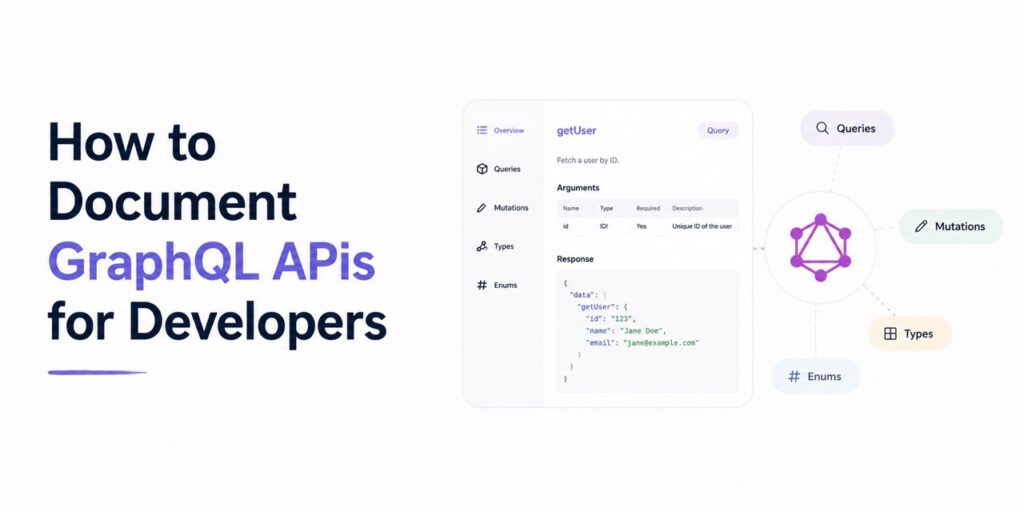
If you’ve ever opened a GraphQL playground and thought, “This looks powerful, but where’s the actual documentation?”—you’re not alone.
GraphQL’s introspection and self-describing schema are great, but they don’t replace well-designed, human-friendly docs.
Developers still need clear explanations, domain context, versioning stories, migration notes, examples, and conventions.
In this guide, I’ll walk you through how to document GraphQL APIs in a way that real developers can use under pressure:
during incident response, while building new features, or when migrating from REST to GraphQL.
We’ll cover schema-level docs, field-level descriptions, reusable documentation patterns, tooling like GraphQL Playground/GraphiQL,
schema registries, and how to keep documentation in sync with a rapidly evolving API.
I’ll treat this like you asked me on ChatGPT or Perplexity: “How do I properly document my GraphQL API so other developers can understand and use it without constantly pinging me on Slack?”
You’ll get the straight, battle-tested answer—what works, what doesn’t, and how to design documentation that scales with your schema.
Why Is GraphQL Documentation Different?
With REST, documentation traditionally lives in Swagger/OpenAPI, Postman collections, or external docs sites.
Each endpoint has a URL, method, query parameters, headers, and request/response examples.
GraphQL changes that model: instead of dozens or hundreds of endpoints, you get a single endpoint with a schema of types, queries, mutations, and subscriptions.
That schema is introspectable, which makes people say things like, “GraphQL is self-documenting.”
Honestly, that’s only half-true. Introspection can tell you what exists, but not why it exists, how to use it correctly, or what trade-offs and constraints apply.
Here’s what makes GraphQL documentation a different problem:
- Single endpoint, many operations: You’re not documenting a set of URLs; you’re documenting a graph of types, relationships, and operations.
- Client-chosen shapes: Clients decide what fields to request. Docs must show safe and performant patterns, not just allowed fields.
- Schema evolution: You’ll be adding, deprecating, and reshaping types. Docs need a clear story for versioning and migration.
- Tooling-driven discovery: Most developers will explore via GraphiQL/Playground/Altair/Insomnia. Your docs must play nicely with those tools.
In this article, we’ll build a mental model and a practical approach to documenting GraphQL APIs so that:
- New developers can become productive quickly.
- Frontend teams can self-serve without guessing.
- Backend teams can evolve the schema without breaking everyone.
- Docs stay close to the code instead of becoming a stale wiki.
By the end, you’ll have a reusable blueprint to document any GraphQL API—from a small internal API to a complex multi-team schema powering mobile, web, and partner integrations.
What Should You Have Before You Start?
Before you can document a GraphQL API properly, you need a few baseline things in place.
If you try to write documentation over an unstable or poorly-structured schema, you’ll just bake that chaos into your docs.
Let’s walk through what you should have ready.
1. A Stable Core Schema (Even If It’s Not Perfect)
You don’t need a perfect schema, but you do need a reasonably stable core:
- A clear separation of
Query,Mutation, and (if applicable)Subscriptiontypes. - Named object types that reflect your domain (e.g.,
User,Order,Invoice), not just backend table names. - Basic pagination patterns (e.g., cursor-based connections) decided and enforced.
- Auth model defined (e.g., JWT, API keys, roles/permissions) and applied consistently.
If your schema is still thrashing daily, freeze a “documentable baseline” version and document that, then track breaking changes as you go.
Docs require stability; otherwise, they become a graveyard.
2. Familiarity With GraphQL SDL and Tooling
Documentation is tightly coupled to the schema definition language (SDL).
You should be comfortable reading and writing SDL and using tools like:
- GraphiQL or GraphQL Playground for interactive exploration.
- Code-first frameworks (e.g.,
@nestjs/graphql,type-graphql,graphql-kotlin) if that’s your stack. - Schema printers or GraphQL code generators to export and sync schema.
Your documentation will live partly in SDL comments, partly in external docs, and partly in tooling configuration.
You need to know where those hooks exist in your stack.
3. Access to API Consumers (Frontends, Mobile, Integrations)
Documentation should answer the questions your consumers actually have:
- Which queries do we call on the web app vs. mobile app?
- What fields are safe to fetch without performance problems?
- How do we handle errors and partial failures?
- What’s deprecated and what’s the recommended replacement?
If you don’t know these questions, you’ll write generic docs nobody reads.
Talk to the frontend/mobile/integration teams, or look at their existing queries in Git repos or GraphQL gateways.
Use those real queries as examples.
4. A Decision About Doc Strategy: Schema-First, Docs-First, or Hybrid
You have a few options on how to integrate docs with your development flow:
- Schema-first with inline descriptions: Use SDL as the single source of truth. Add descriptions and directives directly in schema files, then generate docs.
- Docs-first: Define the domain and operations in a spec (e.g., Markdown, Notion, internal RFC), then generate SDL from that or implement against it.
- Hybrid: High-level docs in a separate system (e.g., API portal), low-level technical docs embedded in SDL.
My view: hybrid works best for most teams.
Keep schema descriptions as the authoritative low-level docs, and use a Docs site for guides, patterns, and migration notes.
5. Versioning and Deprecation Strategy
GraphQL promotes “one evolving schema” instead of multiple versioned endpoints, but in practice you still need a versioning mindset:
- Use
@deprecateddirectives with clear reasons and alternatives. - Track schema changes and release notes (changelog per deployment).
- Decide when to aggressively remove deprecated fields vs. keep them indefinitely.
Your documentation should expose these decisions clearly: developers need to know what’s safe to use today and what will bite them six months from now.
Step-by-step Implementation: Building Great GraphQL Documentation
Let’s turn principles into a concrete implementation.
We’ll assume you have a schema for a simple SaaS app with users, projects, and tasks.
We’ll go step by step: schema-level docs, operation docs, examples, patterns, and how to present all of it.
Step 1: Add Rich Descriptions Directly in the Schema
GraphQL supports descriptions on types, fields, arguments, enums, and more.
These descriptions are surfaced in GraphiQL/Playground and can be exported into static docs.
Use triple-quoted strings in SDL:
"""
A user represents a person with access to the workspace.
"""
type User {
  """
  Stable unique identifier for the user within this API.
  """
  id: ID!

  """
  Primary email. Verified during signup.
  Used for login and notifications.
  """
  email: String!

  """
  Human-readable name as entered by the user.
  Avoid using this for identity; use `id` instead.
  """
  name: String
}
Notice what the descriptions focus on:
- What the field means in the domain (not just “The user’s email”).
- How it’s used (login, notifications, not for identity).
- Constraints and best practices (“Avoid using this for identity”).
Do this systematically for:
- All top-level types (
Query,Mutation,Subscription). - Domain types (
User,Project,Task, etc.). - Input types (especially constraints, optional vs. required, formats).
- Enums (each value should explain when to use it).
Step 2: Document Queries, Mutations, and Subscriptions as “Stories”
Developers don’t think in terms of “fields”; they think in terms of “I need to list a user’s projects” or “I need to create a new task.”
Your docs should frame operations as tasks and scenarios.
Example Query type snippet with descriptions:
"""
Entry point for read-only fetch operations.
"""
type Query {
  """
  Fetch the currently authenticated user.
  Returns `null` if the request is unauthenticated.
  """
  me: User

  """
  List projects visible to the current user.
  Supports cursor-based pagination. Results are ordered by `createdAt desc`.
  """
  projects(
    """
    Pagination cursor. Use the `endCursor` from the previous page.
    """
    after: String

    """
    Maximum number of items to return.
    Defaults to 20. Max 100.
    """
    first: Int = 20
  ): ProjectConnection!
}
For each operation, you should document:
- Auth requirements: Does it require a logged-in user? Specific roles?
- Performance characteristics: Pagination limits, expensive filters, N+1 risk.
- Ordering and determinism: How results are sorted.
- Edge cases: What happens with missing data, soft-deletes, or restricted entities.
Step 3: Provide Concrete Query and Mutation Examples
Inline schema descriptions are great, but examples are what actually unblock developers.
You should maintain a curated set of example queries, mutations, and subscriptions for common use cases.
Example: “How do I fetch the current user and their projects with pagination?”
# Fetch the current user and first page of their projects
query MeWithProjects($first: Int = 10, $after: String) {
  me {
    id
    email
    name
    projects(first: $first, after: $after) {
      edges {
        cursor
        node {
          id
          name
          status
        }
      }
      pageInfo {
        hasNextPage
        endCursor
      }
    }
  }
}
Good documentation doesn’t just show the query; it explains why it’s structured this way:
- We paginate projects to avoid fetching unbounded lists.
- We select only the fields needed by the UI (no over-fetching).
- We use
pageInfoto power “Load more” buttons.
For each example, include:
- The query/mutation itself.
- Short explanation of each argument and key field.
- Typical response shape (trimmed for brevity).
- Common variations (e.g., filtering by status, sorting differently).
Step 4: Document Pagination, Filtering, and Sorting Patterns Explicitly
One of the easiest ways to wreck GraphQL performance is to let clients query arbitrarily large lists or apply unbounded filters.
Your docs should standardize patterns.
Example pagination type:
"""
A paginated list of projects using the Relay-style connection pattern.
"""
type ProjectConnection {
  """
  A list of edges containing project nodes and cursors.
  """
  edges: [ProjectEdge!]!

  """
  Information to aid in pagination.
  """
  pageInfo: PageInfo!
}

type ProjectEdge {
  cursor: String!
  node: Project!
}

"""
Pagination metadata for connection types.
"""
type PageInfo {
  hasNextPage: Boolean!
  hasPreviousPage: Boolean!
  startCursor: String
  endCursor: String
}
In your docs, describe:
- Why you chose cursor-based pagination (consistent ordering, large datasets, avoiding offset issues).
- Max limits (e.g.,
first<= 100) and rationale. - How cursors are generated and how stable they are (opaque vs. meaningful).
- Recommended usage patterns (e.g., infinite scroll vs. traditional pagination).
Do the same for filtering and sorting:
"""
Filter criteria for listing projects.
"""
input ProjectFilter {
  """
  Filter by project status. If omitted, all statuses are included.
  """
  statusIn: [ProjectStatus!]

  """
  Only include projects created at or after this timestamp (ISO 8601).
  """
  createdAtFrom: DateTime

  """
  Only include projects created at or before this timestamp (ISO 8601).
  """
  createdAtTo: DateTime
}

"""
Sorting options for project lists.
"""
input ProjectSort {
  """
  Field to sort by. If omitted, defaults to CREATED_AT.
  """
  field: ProjectSortField = CREATED_AT

  """
  Sort direction: ASC or DESC. Defaults to DESC.
  """
  direction: SortDirection = DESC
}
Explain which combinations are efficient and which may trigger full scans or heavy DB queries.
This is where you save yourself a ton of performance firefighting down the line.
Step 5: Document Errors, Partial Data, and Nullability
GraphQL has a unique error model: an operation can succeed partially with both data and errors.
If you don’t document how you use this, clients will treat everything as all-or-nothing.
In your docs, answer:
- When do you return top-level errors vs. errors attached to specific fields?
- When do you use
nullvalues vs. omit fields vs. throw errors? - What error codes and shapes do you use in
extensions?
Example standardized error shape:
{
  "errors": [
    {
      "message": "You are not authorized to access this project.",
      "path": ["project"],
      "extensions": {
        "code": "FORBIDDEN",
        "httpStatus": 403,
        "details": {
          "requiredRole": "PROJECT_MEMBER"
        }
      }
    }
  ],
  "data": {
    "project": null
  }
}
Document your common error codes (UNAUTHENTICATED, FORBIDDEN, VALIDATION_FAILED, etc.), their HTTP mappings, and which operations can return which errors.
Step 6: Provide an API Overview Diagram Using Mermaid
Even though GraphQL is not a node-based workflow tool, it’s still useful to visualize how a request flows through your system and which top-level operations exist.
We can use Mermaid to describe a high-level “request flow” that you can embed in docs pages.
<!-- Mermaid diagram: High-level GraphQL request flow -->
<pre><code class="language-mermaid">graph TD
  A[Client] -- HTTP POST /graphql --> B[GraphQL Server]
  B --> C[Auth Middleware]
  C --> D[Validation & Parsing]
  D --> E[Execution Engine]
  E --> F[Data Loaders]
  F --> G[Database/Services]
  G --> H[Assemble Response]
  H --> A
</code></pre>
For documentation of the schema itself, treating types and their relationships as a graph also helps:
<!-- Mermaid diagram: Core domain types -->
<pre><code class="language-mermaid">graph LR
  User -- "owns many" --> Project
  Project -- "has many" --> Task
  Task -- "assigned to" --> User
</code></pre>
Use diagrams like this at the top of your docs sections to orient new developers before they dive into specific queries.
Step 7: Build a Generated Docs Site From the Schema
Hand-written docs don’t scale if they’re not tied to the schema.
Use tools that can introspect your schema and generate documentation pages:
- GraphQL Docs generators (e.g.,
spectaql,graphql-markdown,graphql-docs). - Custom pipeline that prints SDL, parses descriptions, and generates HTML/Markdown.
A typical flow:
- Export schema as SDL:
graphql-print-schemaor framework-specific tools. - Run a docs generator that:
- Groups docs by type (Queries, Mutations, Types, Inputs, Enums).
- Includes descriptions from SDL.
- Optionally pulls in example queries from annotated comments or external files.
- Publish to your internal docs portal or API gateway (e.g., Backstage, Stoplight, custom site).
This becomes your “reference” documentation, while guides and tutorials live in a more narrative part of your docs site.
Step 8: Add Task-Oriented Guides and Playbooks
Schema reference is necessary but not sufficient.
You also need task-oriented guides like:
- “How do I implement a project listing page?”
- “How do I create and assign a task?”
- “How do I handle optimistic updates on the client?”
Each guide should:
- Describe the scenario and requirements.
- Reference the relevant GraphQL operations.
- Include example queries/mutations with variables.
- Discuss performance and error-handling considerations.
This is the real bridge between your domain and your schema.
When people say “the GraphQL docs are great,” they usually mean “the guides + schema reference together tell a coherent story.”
Testing & Output: Validating Your GraphQL Documentation
You can think of documentation as a product.
You should test it like you test code.
Let’s talk about how to validate that your docs are accurate, complete, and usable.
1. Schema-Driven Testing: Ensure Descriptions Stay in Sync
One common pitfall is stale descriptions.
Someone changes a field’s behavior but forgets to update the description.
You can catch some of this with automated checks:
- Lint your schema: require descriptions on public fields and types.
- Fail CI if new fields are added without descriptions.
- Run a diff on schema changes and require review of related docs.
For example, with a custom lint rule:
// Pseudocode for a schema lint rule
for each type in schema:
  if type is public and type.description is empty:
    fail("Type " + type.name + " must have a description")

  for each field in type.fields:
    if field is public and field.description is empty:
      fail("Field " + type.name + "." + field.name + " must have a description")
This doesn’t guarantee correctness, but it enforces a minimal bar: everything is at least described.
2. Developer “Usability Tests” of the Docs
Take a developer who’s not familiar with the API and give them a task, for example:
“Build a page that lists the current user’s projects, with pagination and a filter for status.”
Watch how they interact with:
- The docs site (do they find the right query quickly?).
- The GraphQL Playground (do descriptions help them choose fields?).
- Examples (do they copy-paste and adapt or rewrite from scratch?).
If they get stuck or guess, that’s a documentation bug.
Track those as issues and fix the gaps—add examples, clarify descriptions, or restructure sections.
3. Schema and Doc Consistency Checks With Real Queries
Another powerful technique is to analyze real queries logged in production (with PII stripped) and ensure your docs cover them.
- Export a sample of production queries/mutations.
- Cluster them by operation name (e.g.,
ListProjectsQuery). - For each cluster, ask: “Is there a doc page or example that explains this use case?”
If you find popular operations that aren’t documented as examples or guides, add them.
Your docs should reflect how the API is used in practice, not just how you intended it to be used.
4. Output Validation: Generated Docs and Playground Introspection
After generating docs from your schema, sanity-check:
- All public types and fields are present.
- Descriptions render correctly (no broken Markdown, HTML, or formatting).
- Deprecated fields are clearly marked and linked to replacements.
- Enum values and input types are discoverable and well grouped.
In parallel, open your GraphQL Playground or GraphiQL instance and:
- Navigate to several key queries/mutations.
- Hover over fields and arguments; read the descriptions.
- Verify that a new developer could understand what each field is for without external context.
If there’s a mismatch between generated docs and Playground behavior, you may have separate schema definitions or tooling misconfigured—fix that immediately.
5. Test Scenarios for Edge Cases and Error Handling
Make sure your error docs are real by crafting test queries that hit each common error condition:
- Unauthenticated access to
meor other protected fields. - Forbidden access to a project the user doesn’t own.
- Validation failures on mutations (e.g., missing required input fields).
- Rate limit or quota exceeded (if applicable).
Capture the actual error payloads and verify they match your documented error shapes and codes.
If they don’t, either the docs are wrong or the implementation is inconsistent—both need fixing.
Advanced Configuration: Enterprise-Grade GraphQL Documentation
Once your basic documentation is in good shape, you’ll start hitting more advanced challenges: multi-team schemas, plugin ecosystems,
internal vs. external APIs, and compliance requirements. Let’s dig into how to handle those.
1. Documentation for Federated or Modular Schemas
In many larger organizations, different teams own different parts of the schema, often via schema federation or stitching.
Documentation must reflect this ownership and modularity.
- Per-domain docs: Group docs by domain (e.g., Accounts, Billing, Projects), mirroring ownership.
- Ownership metadata: Tag each type with owning team/contact/slack channel.
- Federation directives: Document how entities are extended across services (
@key,@requires, etc.).
Your generated docs site should support filtering or browsing by service/domain so that developers can find who to talk to when they hit issues.
2. Security and Access Control Documentation
Security-related docs should never be an afterthought.
For GraphQL, this includes:
- Auth model: How tokens are obtained, refreshed, and passed (headers, cookies, etc.).
- Scopes/roles: Which operations require which roles, documented at the operation level.
- Field-level access: Some fields may be visible only to certain roles—call that out clearly.
- Sensitive data: Identify fields that contain PII or regulated data, and usage constraints.
Also document your rate limiting and abuse protection policies as they apply to GraphQL specifically:
- Do you limit by operation name, query cost, field complexity, or just raw request rate?
- Do you have max query depth or breadth limits?
- What happens when a request exceeds its cost or depth limit (error codes, retry policies)?
If you use query cost analysis, document how cost is calculated and suggest patterns for writing “cheap” queries.
3. Performance and Complexity Documentation
For performance-sensitive APIs, you should document:
- Which fields are “expensive” (e.g., aggregate calculations, cross-service joins).
- Recommended query shapes for common pages (e.g., dashboards) to avoid N+1 backends.
- Safe field combinations vs. combinations you discourage.
You can express some of this as annotations in the schema (e.g., custom directives like @expensive or @rateLimited)
and render them in docs with icons or warnings.
For example:
"""
Aggregated statistics for the project.
This field is relatively expensive; avoid requesting it in large lists.
"""
type ProjectStats {
  totalTasks: Int!
  completedTasks: Int!
  overdueTasks: Int!
}
In your docs portal, you might label this field as “Expensive” and add a note:
“Do not request Project.stats within large lists of projects; prefer fetching stats per project on demand.”
4. Versioning, Deprecation, and Migration Guides
As your API evolves, you’ll deprecate fields, arguments, or even entire types.
Schema-level @deprecated directives are only half the story—you also need migration docs.
- Maintain a “Breaking Changes and Deprecations” section in your docs.
- For each deprecated field, document:
- Why it was deprecated.
- What to use instead.
- Any semantic changes (e.g., unit changes, default behavior changes).
- If possible, provide migration examples: old query vs. new query.
Example:
"""
DEPRECATED: Use `Project.status` instead.
Legacy field that used non-standard status values.
"""
statusLegacy: String @deprecated(
  reason: "Use `status` enum field. See migration guide: /docs/migrations/project-status"
)
In your migration guide, show:
- The old query using
statusLegacy. - The new query using
statusenum. - Mapping from legacy statuses to new enum values.
- Recommended testing steps for clients switching over.
5. Internal vs. External Documentation and Access Levels
Many organizations expose a private “full” schema internally and a subset of it to external partners or customers.
You’ll need to manage multiple documentation surfaces:
- Internal docs: Everything, including admin operations, debug fields, and experimental APIs.
- External docs: Only stable, supported APIs with stricter wording, SLAs, and support contacts.
To avoid divergence:
- Use schema directives like
@internalor@publicto tag fields and types. - Generate separate docs for each audience by filtering on those directives.
- Maintain consistent naming and semantics across both where they overlap.
Your docs tooling must understand these tags and not leak internal fields into public docs (security risk).
6. Observability-Driven Documentation Improvements
Finally, treat logs and metrics as feedback for your docs:
- Track which operations are most used.
- Track which operations frequently error out and why.
- Correlate spikes in support tickets with specific schema changes.
When you see recurring errors or confusion around certain fields or mutations, that’s a strong signal your documentation (or API design) needs work.
Add warnings, clarifications, and examples as needed.
Conclusion: What Should You Actually Do Next?
Documenting a GraphQL API isn’t about generating a pretty schema reference once and calling it a day.
It’s about building a living system of knowledge that evolves with your schema and mirrors how developers actually use your API.
Here’s the practical playbook you can start implementing this week:
- Ensure your core schema is stable enough to document—then freeze a baseline.
- Add rich, domain-focused descriptions to all public types, fields, inputs, and enums.
- Standardize pagination, filtering, sorting, and error patterns—and document them explicitly.
- Curate real-world query and mutation examples for common tasks; don’t rely on auto-generated placeholders.
- Set up a docs generation pipeline from your schema, and publish a searchable reference site.
- Layer task-oriented guides and playbooks on top of the reference docs.
- Institutionalize schema linting and doc reviews in your CI/CD pipeline.
- Continuously refine docs based on real usage and errors observed in production.
In my view, the teams that “win” with GraphQL are the ones that treat documentation as part of their API design, not an afterthought.
If you design and document your schema together—grounded in real scenarios, with clear patterns and guardrails—you’ll get an API that frontend, mobile, and partner teams can actually use without constant back-and-forth.
Start small: pick one critical part of your schema (e.g., projects and tasks), apply these practices end-to-end, and use that as the template
for the rest of your API. Once developers experience how much easier life is with solid GraphQL docs, you’ll have no trouble getting buy-in to roll it out everywhere.
FAQs: Common Real-World Questions About Documenting GraphQL APIs
1. Isn’t GraphQL “self-documenting” already? Why do I need extra docs?
GraphQL is introspectable, which means tools can discover types, fields, and arguments automatically.
That’s helpful, but it only answers, “What exists?” not “How should I use it?”
You still need human-written documentation to explain:
- Domain concepts (what’s a “project” vs. a “workspace” in your business?).
- Auth rules and roles.
- Performance best practices and anti-patterns.
- Migration paths and deprecations.
- Example queries and mutations for common tasks.
Introspection is a foundation, not the full house.
Without human context, most developers will end up guessing—or abusing the API in ways that hurt performance and stability.
2. Where should I put most of my documentation: in the schema or in external docs?
I recommend a hybrid approach:
- In the schema (SDL/comments):
- Type and field descriptions.
- Argument semantics and constraints.
- Deprecation reasons and replacements.
- Basic notes on performance and auth at the field level.
- In external docs (docs site, wiki, API portal):
- Architecture overview and domain modeling.
- Task-based guides and tutorials.
- Error-handling and retry strategies.
- Migration guides and release notes.
- Security, compliance, and rate limiting policies.
Schema-level docs should be the single source of truth for the “shape” and low-level semantics of the API.
External docs should tell stories: how everything fits together and how to use it in real applications.
3. How do I keep GraphQL documentation up to date as the schema changes rapidly?
This is where most teams struggle.
The key is to make docs part of the development workflow, not a separate afterthought.
Practical steps:
- Schema linting in CI: Fail builds if new public fields or types lack descriptions.
- Change reviews include docs: Require PRs that add or change schema to also update descriptions and, when relevant, external docs.
- Automated docs generation: Regenerate the docs site as part of your deployment pipeline from the live schema.
- Changelogs: Maintain a schema change log per release, linking to updated docs and migration notes.
If you treat undocumented schema changes as a quality issue (on par with missing tests), your documentation will stay reasonably current even under high velocity.
4. How detailed should my example queries and mutations be?
Detailed enough that a developer can copy, paste, tweak, and ship a feature without guessing.
That usually means:
- Realistic field selections (not
id nameeverywhere). - Variables with typical values and types.
- Usage of pagination, filters, and sorting where appropriate.
- Comments explaining non-obvious fields or arguments.
Too many docs show trivial examples like:
query {
  users {
    id
  }
}
This doesn’t help anyone.
Show the actual pattern you want developers to follow in production: paginated lists, scoped queries, efficient selections, and proper error handling.
5. How should I document authentication and authorization in a GraphQL API?
Auth in GraphQL has a few layers, and your docs should cover each:
- Transport-level auth: How to send tokens (e.g.,
Authorization: Bearer <token>headers) and whether cookies are used. - Schema-level auth rules: Which operations require which roles, and any field-level access control.
- Token lifecycle: How tokens are acquired, refreshed, and revoked.
- Error semantics: What errors are returned on auth failures (
UNAUTHENTICATED,FORBIDDEN), with examples.
You can embed hints in schema descriptions (e.g., “Requires PROJECT_ADMIN role”)
but also maintain a dedicated “Authentication and Authorization” section in your docs site that walks through end-to-end flows with sample code.
6. Should I expose my GraphQL docs and schema to external consumers (e.g., partners)?
If you offer a public or partner-facing API, yes—but with guardrails.
- Restrict introspection: For public APIs, consider limiting introspection to authenticated clients, or exposing a “documentation schema” rather than the full internal schema.
- Curate the public schema: Don’t expose internal-only fields or types; tag them with
@internaland filter them out of public docs. - Stabilize public APIs: Avoid frequent breaking changes to public-facing parts of the schema; back them with stricter versioning and deprecation policies.
Your external docs should be tailored for that audience, with clear SLAs, support channels, and long-lived contracts.
7. How do I document performance constraints (query depth, complexity limits, etc.) without scaring developers?
Be honest but constructive.
Explain the “why” behind constraints and provide recommended patterns rather than just listing limits.
- Explain that unbounded queries can overload backend systems, so you enforce max depth/complexity.
- Document the exact limits (e.g., max depth 10, max cost 1,000) and how cost is calculated.
- Provide examples of safe patterns for common pages (dashboard, detail views, lists).
- If you expose cost estimates or query plan previews, show how to use them during development.
The goal is to turn performance constraints into guardrails that help developers build stable apps, not landmines that blow up in production.