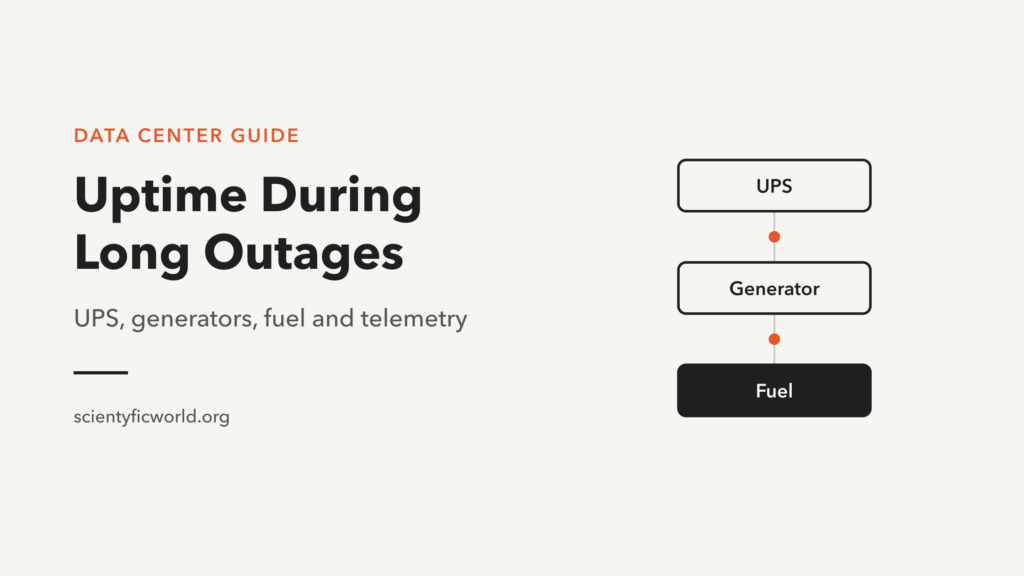
Data centers protect uptime during extended outages with a layered power strategy: UPS batteries carry the load for the first seconds and minutes, generators take over through automatic transfer switches, and a fuel plan keeps those generators running for days. Each layer must start quickly, carry the right load and hand off cleanly to the next. Whether a facility stays online through a multi-day outage usually depends less on the equipment itself than on having enough fuel, reliable monitoring and procedures tested under realistic conditions.
The Mechanics of Uninterrupted Power
Utility power normally feeds a data center through switchgear and power distribution equipment. When the incoming voltage falls outside acceptable limits, the power chain switches over in stages:
| Stage | What happens | Role |
|---|---|---|
| 1. UPS | An uninterruptible power supply picks up the load immediately, with no break in power | Bridges the gap until generators are ready |
| 2. Generators | Generators start and stabilize, often within seconds | Long-duration power source |
| 3. Transfer | Automatic transfer switches move the load once generator output reaches the correct voltage and frequency | Connects generators to the facility |
| 4. Fuel | Stored fuel, then scheduled deliveries, keep the generators running | Sets how long the facility can stay on generator power |
A clear guide to data center UPS systems explains how these units condition incoming power as well as providing short-term backup.
Test the full sequence under realistic load, including cooling systems, pumps and controls, not just the generator on its own. A successful generator start means little if a failed transfer switch stops power from reaching the server floor.
Why Battery Banks Are Only Step One
UPS batteries bridge the gap between a utility failure and generator availability. Depending on the design and the load, that bridge may last only a few minutes. Batteries are taking on more work in modern facilities, such as managing peak demand, a trend covered in research on AI data center batteries. But they are not built to carry a facility through a multi-day outage.
Long-duration resilience depends on enough generation capacity, well-maintained generators and reliable access to fuel. Two habits help:
- Calculate runtime at several load levels. Fuel consumption changes as cooling demand rises, so a runtime figure based on average load can be badly optimistic on a hot day.
- Document alternative supply options in advance. The middle of an emergency is the worst time to look for a second fuel supplier.
Scheduling Recurring Fuel Replenishment
Fuel planning starts with a realistic burn-rate calculation. For example, if a generator consumes 250 gallons per hour at the expected load and usable storage holds 6,000 gallons, the theoretical runtime is 24 hours (6,000 ÷ 250). Actual operating time will be shorter once you account for reserve levels, testing and fuel that cannot be drawn from the bottom of the tank.
Replenishment plans then need to account for delivery lead times, site access requirements and the likelihood that fuel demand rises across the whole region during a widespread outage. Arranging on-site fuel delivery can help businesses plan how fuel reaches equipment when it is needed. Before relying on any arrangement, confirm that the supplier can meet the facility’s required volumes, delivery schedule, fuel specifications and emergency response needs.
A few rules help a fuel plan hold up under pressure:
- Set reorder thresholds well above the minimum reserve. During a regional outage, closed roads, high demand and driver shortages can all delay a delivery.
- Put the details in the contract. Define delivery frequency, emergency contacts, site access procedures and who receives deliveries after hours.
- Check fuel quality. Stored diesel can collect water or become contaminated, which affects generator reliability. Have a method for testing it regularly.
Automating Facility-Level Telemetry
Centralized telemetry warns operators early when power or fuel conditions start to deteriorate. Connect generators, transfer switches, UPS units, batteries, cooling systems and fuel tanks to the building management system or data center infrastructure management (DCIM) platform. The system should record every status change with an accurate timestamp, so the team can reconstruct the sequence of events afterwards.
Power and fuel are only part of the picture. Cooling affects reliability too, because server temperatures can rise quickly when airflow or cooling equipment fails. Our guide to optimizing data center performance and efficiency covers how monitoring and cooling controls help teams catch problems before they affect operations.
Design alerts around conditions that need action:
- Alert on what matters: falling tank levels, repeated generator start failures or abnormal battery temperature, not every minor fluctuation.
- Route alarms deliberately: send critical alarms to the staffed operations channel rather than to every employee.
- Give every alert an owner: each one needs a responsible person, a response time and an escalation path.
- Show runtime, not percentages: during an outage, a dashboard showing remaining runtime in hours at the current load is far more useful than a raw fuel percentage.
Lessons from Severe Weather Events
Severe storms rarely break just one thing. Utility power may fail while telecommunications weaken, roads flood and supplier schedules slip. Continuity plans should assume that normal staffing levels and delivery times will not hold during a widespread event.
Run exercises that go well beyond a short generator test. A useful scenario might simulate:
- a 72-hour utility outage,
- one delivery route that is unavailable, and
- a cooling alarm during the second night.
During the exercise, confirm that backup contacts can authorize purchases, that security can admit approved fuel drivers and that technicians can reach critical equipment safely. After every drill or real event, compare predicted fuel use with actual consumption and update the reorder thresholds.
Conclusion
Uptime during an extended outage comes from layers that hand off cleanly: UPS batteries for the first minutes, generators and transfer switches for the hours after, and a fuel plan for the days beyond. The most revealing test is the handoff between systems and people. If operators know exactly when to transfer load, when to request more fuel and when to escalate an alarm, the facility has a practical plan for staying online when restoration takes longer than expected.
How do data centers stay online during a power outage?
They use layers of backup power. UPS batteries carry the load instantly, generators start within seconds, automatic transfer switches move the load to the generators, and stored fuel plus scheduled deliveries keep the generators running.
How long can UPS batteries power a data center?
Often only a few minutes, depending on the design and the load. UPS batteries are a bridge until the generators are running, not a long-term power source.
How do you calculate generator fuel runtime?
Divide usable fuel by the burn rate at the expected load. For example, 6,000 usable gallons at 250 gallons per hour gives a theoretical 24 hours. Real runtime is shorter once reserve levels, testing and unusable fuel are accounted for.
Why does fuel quality matter for backup generators?
Stored diesel can collect water or become contaminated, which can make generators unreliable when they are needed most. Facilities should test stored fuel regularly.
How should a data center test its outage plan?
Run realistic multi-day scenarios, such as a 72-hour outage with a blocked delivery route and a cooling alarm, and check that people, suppliers and systems all respond as planned. Then compare predicted and actual fuel use and update thresholds.