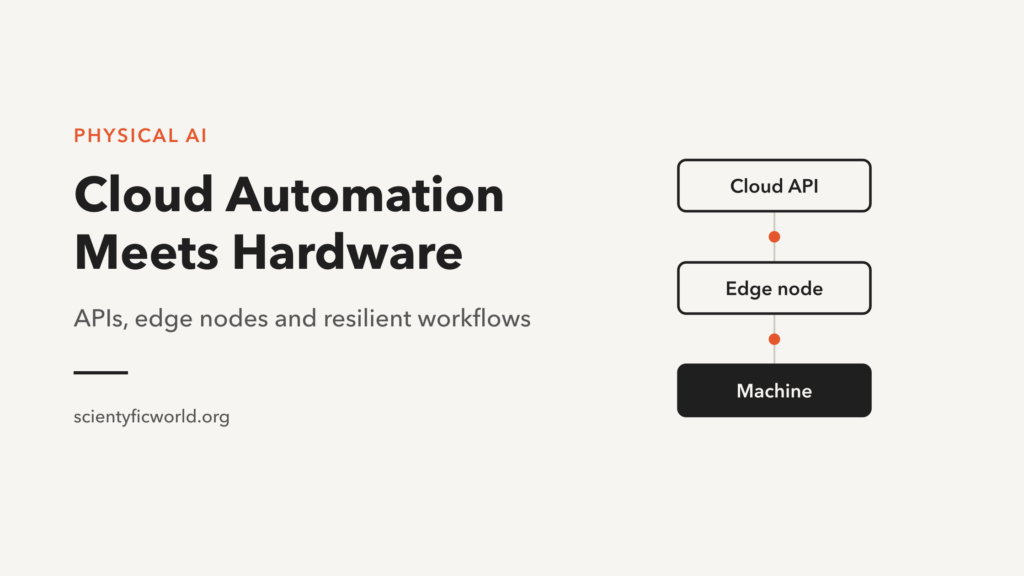
When cloud automation expands into physical hardware, the main change is that a “success” response no longer means the job is done. Software now coordinates robots, autonomous aircraft and remote equipment, bringing familiar tools such as APIs, event queues and monitoring dashboards into environments shaped by weather, mechanical wear and unreliable connectivity. Teams can still automate at scale, but they have to verify real-world outcomes, keep safety decisions on the device, and design for the fact that an action, once taken, cannot simply be rolled back.
This combination is often called physical AI: a broad category that brings together computing, sensors and machines that act on their surroundings. Turning it into a dependable operation takes much more than connecting a model to a motor.
Breaking Out of the Digital Sandbox
Traditional workflow automation runs in a controlled digital setting. If a software job fails, an orchestration platform can restart it, move it to another server or restore an earlier state. Physical systems have different limits. A mobile robot can meet a closed door, an automated aircraft may face unsafe weather, and an inspection camera can be obscured by dust.
That changes how teams define success. A completed API request only confirms that a command reached the next service. It does not prove that the equipment performed the action or produced useful data. Confirmation has to come from several layers: the control software, the onboard sensors and the surrounding environment.
Moving from prototype to working operation has become a central issue in physical AI deployment. A demonstration may run for 20 minutes under supervision. A production system may need to work every day through changing temperatures, software updates and intermittent network service.
Start by defining physical outcomes in measurable terms. An inspection mission might count as complete only when the machine has reached every planned checkpoint, captured readable images and uploaded them with valid timestamps. Those conditions give the cloud platform concrete evidence to evaluate, and they prevent a misleading “success” status when the command ran but the real task was never finished.
Connecting APIs to Robotic Deployments
APIs are a practical bridge between business systems and robotic equipment. A maintenance platform could detect an urgent inspection request, send a mission to an orchestration service and receive imagery or sensor readings when the equipment returns. The same workflow can notify an operator when conditions prevent deployment.
Before connecting these systems, map each stage of a mission as a state transition. Explicit states let other applications understand what is happening without relying on vague status messages:
| State | Meaning |
|---|---|
| Requested | A system or person has asked for the mission |
| Validated | The request passed checks on route, permissions and parameters |
| Scheduled | The mission has a time slot and assigned equipment |
| Active | The equipment is carrying out the mission |
| Returning | The task is finished and the equipment is heading back |
| Processing | Collected data is being checked and stored |
| Complete | Data is verified and stored; the mission is closed |
| Delayed / Failed | Separate states for missions that cannot proceed, with a recorded reason |
Organizations considering automated aerial operations should also compare how docking, battery handling, environmental tolerance and live data transmission fit into the wider software workflow. The DJI Dock 4 is one example of a system designed for automated missions, rapid battery swapping, extended operations and real-time streaming. A technical review should still confirm that any platform matches the organization’s operating requirements, site conditions and applicable regulations.
Three integration rules matter more here than in purely digital systems:
- Keep an approval layer for high-impact actions. An API can create and validate a mission automatically while requiring a qualified person to approve unusual routes or uncertain conditions.
- Lock down access. Use signed requests, short-lived credentials and strict permission scopes, so a scheduling application cannot reach unrelated equipment functions.
- Make mission creation idempotent. Networks retry requests when acknowledgments arrive late. Give every mission a unique identifier so a repeated API call returns the existing job instead of launching a second physical deployment.
Managing Edge Nodes Without Human Presence
An unattended edge node must keep making safe decisions when its cloud connection disappears. It may need to pause work, store data locally or return equipment to a known state. The right response depends on the operation, but it should be decided before deployment and tested under realistic conditions.
Give each node a local policy covering connectivity loss, low energy, sensor faults and environmental limits. The cloud sets the overall task; local controls decide whether immediate conditions allow it. This split keeps time-sensitive safety checks close to the hardware, where they do not depend on a round trip to a distant server.
Remote management also needs clear visibility. Track power status, storage capacity, temperature, software version and the timestamp of the last successful task. The dashboard should distinguish a healthy idle node from one that has stopped reporting, and alert thresholds should reflect operational urgency: a five-minute communication gap may be routine at a remote industrial site, while an hour without contact could call for an onsite inspection.
Treat software updates as staged releases:
- Send the new version to one or two low-risk nodes first.
- Observe them through several complete task cycles.
- Expand the rollout only once the results stay stable.
- Keep the previous version available for rollback, and make sure a node that fails mid-update boots from a known working image rather than an undefined state.
This local autonomy is one reason industrial physical AI depends on coordination between software, sensors and machinery. Cloud intelligence can optimize the fleet, but each edge device still needs enough logic to protect itself and complete basic recovery steps.
Designing Resilient Hardware Workflows
Resilience starts from the assumption that some component will fail. Batteries lose capacity, sensors drift and network links drop without warning. A good workflow detects those failures early and moves the system into a controlled state.
Build around observable checkpoints. After receiving a task, the system should confirm its configuration, available energy, storage space, connectivity and operating conditions. During execution, it should report progress at defined intervals. At completion, it should verify that collected files are readable and safely stored before marking the task complete.
A practical resilience plan answers four questions:
- What conditions stop a task before it starts?
- Which failures allow an automatic retry?
- When must the equipment return to a safe state?
- What evidence does an operator need to resume work?
Retries need limits
Retries need particular care in physical automation. Repeating a database query is usually low risk. Repeating a movement or a deployment can waste energy, duplicate data or put extra strain on components. Set firm retry limits and require fresh sensor checks before each attempt. For a recurring inspection, the scheduler should also check whether the previous run already gathered valid data.
Test the failure paths
Test failure paths as seriously as normal operations. Disconnect the network during a task, simulate a low-energy warning and send malformed input to the mission API. Confirm that logs from the cloud, the edge node and the equipment share synchronized timestamps. When an incident happens, that common timeline shows whether the first fault came from software, communications or hardware.
Operational records should also capture configuration changes and manual interventions. If a technician replaces a sensor or adjusts a local setting, the central system needs to know. Otherwise, engineers can spend hours diagnosing behaviour that came from an undocumented field change.
Conclusion
The strongest hardware workflows make uncertainty visible. A dashboard that labels incomplete data, delayed communication and degraded sensors gives operators a truthful picture of the system, and that is what lets cloud automation extend into the physical world without treating real equipment like another disposable software process. Before scaling from one site to many, run a full recovery exercise at the first location. A system that can lose connectivity, preserve its data and return to a known state has earned the next deployment.
What is physical AI?
Physical AI is a broad category of systems that combine computing, sensors and machines that act on the physical world, such as robots, autonomous aircraft and automated inspection equipment.
How is automating hardware different from automating software?
Software failures can usually be retried or rolled back. Physical actions cannot be undone, and a successful API call does not prove the equipment completed the task, so outcomes must be verified through sensors and the environment.
What should an edge device do when it loses its cloud connection?
Follow a local policy defined before deployment, for example pausing work, storing data locally or returning equipment to a known safe state. Safety checks should run on the device, not depend on the cloud.
Why do robotic APIs need idempotency?
Networks retry requests when acknowledgments arrive late. Without a unique mission identifier, a repeated API call could trigger a second physical deployment instead of returning the existing job.
How should software updates be rolled out to edge devices?
In stages: update one or two low-risk nodes first, observe several complete task cycles, then expand. Keep the previous version available for rollback and make sure a failed update boots into a known working image.