Agentic AI is an approach to building AI systems that pursue a goal on their own. Instead of answering one prompt and stopping, the system plans the steps, calls tools, checks what happened and adjusts, looping until the goal is met or a human needs to step in.
Unlike traditional AI models that respond to prompts in isolation, agentic systems operate as goal-oriented agents. They can carry memory, make decisions across multiple steps, use external tools or APIs, and even collaborate with other agents — all while maintaining contextual awareness. This shift turns LLMs into autonomous workers, not just assistants.
Updated September 2026: I’ve refreshed the framework section (AutoGen is now in maintenance mode, and the OpenAI, Claude and Microsoft agent toolkits are in), added MCP and A2A, a workflows-vs-agents guide, security and cost realities, and a product checklist for deciding whether you need an agent at all.
A note on terminology: this post also used to live at a second URL, “What is an AI Agent?” — I’ve merged the two. “AI agent” is the older, broader term (any system that perceives its environment and acts on it); “agentic AI” is the 2023-onward wave of agents built around LLMs specifically. In practice, almost everyone now uses the two terms interchangeably, so rather than maintain two overlapping pages, this one covers both: the classical agent theory below, and the modern LLM-agent stack in the rest of the post.
Why does this matter now? A single model call is stateless. It only sees what is in the prompt, and on its own it can’t act on the world. Real applications, from automated customer workflows to research assistants that run for hours, need persistence, tool access and multi-step decision-making. Every major AI platform vendor now ships a toolkit for exactly this (OpenAI’s Agents SDK, Anthropic’s Claude Agent SDK, Google’s Agent Development Kit and Microsoft’s Agent Framework), and open standards like MCP are settling how agents connect to tools.
In this guide I’ll break down how agentic AI works, how it’s architected, which frameworks are worth your time in 2026, and, just as important, when you should not build an agent.
What is Agentic AI?
Agentic AI is a class of intelligent systems where large language models (LLMs) are configured to act as autonomous agents. These agents don’t just respond to prompts; they take responsibility for achieving defined goals by reasoning over inputs, planning actions, using tools, interacting with environments, and iterating based on results.
Agentic AI treats LLMs as components within a larger decision-making system. These systems are designed to exhibit traits such as goal-directed behavior, context retention, adaptive execution, and tool-use capabilities. Rather than producing a single answer per input, agentic systems operate through multi-step workflows, adjusting decisions along the way and coordinating across internal modules or other agents.
This idea borrows from decades of research on autonomous agents and software agent architectures. What changed is that modern LLMs, from OpenAI, Anthropic, Google and open-weight families, can interpret goals, generate subtasks, reflect on their outputs and call external APIs with far less hardcoded logic.
Today, Agentic AI is being implemented in diverse domains—automated research, intelligent coding assistants, autonomous customer support flows, and backend operations. Its appeal lies in moving beyond prompt-based single completions, allowing intelligent systems to act, adapt, and learn from previous cycles continuously.
The Classical Building Blocks: PEAS and Agent Types
Before LLMs, “AI agent” already had a precise meaning in computer science, and it’s worth knowing because the vocabulary still shapes how people talk about agentic systems today. An agent, in the classical sense from Russell & Norvig’s Artificial Intelligence: A Modern Approach, is anything that perceives its environment through sensors and acts on that environment through actuators. A thermostat qualifies. So does a chess program. So does GPT-5 wired up to a browser.
The PEAS framework
PEAS is a checklist for specifying exactly what an agent’s task environment is, before you design the agent itself:
- Performance measure: how you’ll judge success. For a customer-support agent, that might be resolution rate and time-to-resolution; for a self-driving car, safety, legality, and time-to-destination.
- Environment: what the agent operates in and what it can’t control. A web-browsing agent’s environment includes every page it might land on, including ones designed to mislead it.
- Actuators: how the agent acts. For a physical robot, motors and grippers; for a software agent, function calls, API requests, or a browser it can click and type into.
- Sensors: how the agent perceives. Cameras and microphones for a robot; for a software agent, whatever gets fed into its context window — a screenshot, a database query result, a tool’s return value.
Run any LLM agent through PEAS and the exercise pays for itself: most agent failures trace back to an underspecified performance measure (the agent optimized for the wrong thing) or an environment assumption that didn’t hold (a tool’s output format changed, a page layout shifted).
Agent types, from simplest to most capable
The classical taxonomy also gives you a useful way to place where today’s LLM agents actually sit:
| Agent type | How it decides | LLM-agent equivalent |
|---|---|---|
| Simple reflex | Fixed rule triggered directly by the current percept, no memory. | A single prompt-response call with no conversation history. |
| Model-based reflex | Keeps an internal model of the world to handle partial observability. | An agent with a context window or scratchpad tracking state across steps. |
| Goal-based | Considers future action sequences and picks ones that reach a goal. | A planning-and-execution agent (ReAct, plan-then-act) working toward a stated objective. |
| Utility-based | Picks among multiple goal-achieving paths using a preference/utility function, not just “does it work.” | An agent with an explicit reward model or a reflection step that scores candidate actions. |
| Learning | Improves its own performance element over time from experience. | An agent whose memory or fine-tuning loop lets it get better at a recurring task across runs. |
Most production LLM agents today are goal-based, with a thin layer of model-based state tracking (that’s what “memory,” covered below, is doing) and occasionally a utility-based reflection step bolted on. True learning agents — ones that improve their own weights from deployment experience rather than just accumulating notes in a memory store — are still rare outside research settings.
Workflows vs agents: which one do you actually need?
This is the distinction that saves the most time and money. Anthropic’s widely cited guide to building effective agents separates two kinds of system. In a workflow, LLMs and tools are orchestrated through predefined code paths that you wrote. In an agent, the LLM dynamically decides its own process and which tools to use. Both are “agentic” in the loose sense, but they behave very differently in production.
| Workflow | Agent | |
|---|---|---|
| Who decides the next step | Your code | The model |
| Predictability | High: the path is fixed | Lower: the path varies per run |
| Cost and latency | Lower and easier to estimate | Higher, and harder to bound |
| Best for | Well-defined, repeatable processes | Open-ended problems where you can’t predict the steps |
| Typical failure | Breaks on inputs you didn’t anticipate | Drifts, loops, or takes an unwanted action |
Anthropic’s advice is to find the simplest solution that works and add complexity only when it earns its keep, because agents trade latency and cost for better performance on hard tasks. Microsoft’s Agent Framework documentation says the same thing more bluntly: if you can write a function to handle the task, do that instead of using an AI agent.
Between “one prompt” and “fully autonomous agent” sit a handful of proven workflow patterns:
- Prompt chaining: break a task into sequential steps, each LLM call processing the previous output.
- Routing: classify an input and send it to a specialised downstream path.
- Parallelization: run independent subtasks at once, or run the same task several times and compare.
- Orchestrator-workers: a central LLM splits the task dynamically and delegates to worker LLMs.
- Evaluator-optimizer: one LLM produces a draft and another critiques it in a loop.
If a workflow pattern solves your problem, ship that. Reach for a true agent when the number of steps really can’t be predicted. For a hands-on look at the workflow side, see What is Workflow Automation?.
How Agentic AI Works: Step-by-Step
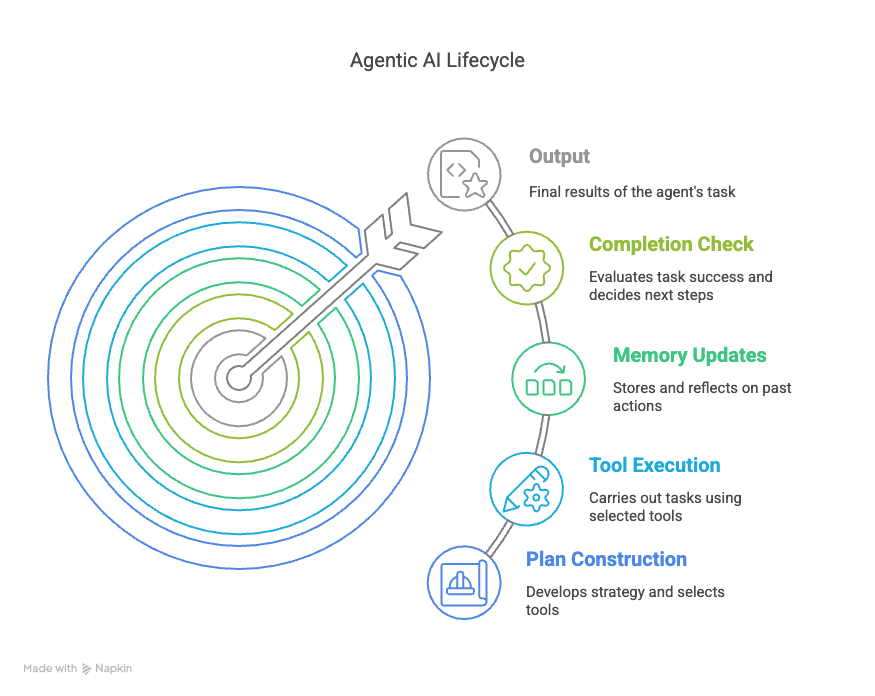
Agentic systems follow a structured execution cycle. Each agent operates as a process with state, memory, and autonomy. Below is a typical step-by-step breakdown of how an agentic AI handles a given objective:
1. Input Reception and Goal Parsing
The process begins with the agent receiving an input — often a user-defined goal, a request, or a task description. The agent interprets this prompt to determine intent, extract parameters, and break down the overarching objective into manageable steps.
For example, if the input is “Summarize this 20-page document and send a report to my team,” the agent:
- Parses the command
- Identifies that summarization, formatting, and communication are involved
- Plans accordingly
2. Tool Selection and Planning Module Activation
Once the goal is parsed, the agent determines which tools, APIs, or actions are required to fulfill it. This step typically activates a planning module — often implemented via frameworks like ReAct (Reason + Act), Tree of Thoughts, or LangGraph.
The planning module:
- Defines intermediate steps or checkpoints
- Sequences operations logically
- Selects relevant tools (e.g., document parsers, summarizers, email APIs)
This phase can be either rule-based or LLM-generated, depending on the framework and execution design.
3. Task Execution: Sequential or Multi-Agent
The agent begins executing tasks either sequentially or in coordination with other specialized agents. Multi-agent frameworks like CrewAI or Microsoft Agent Framework allow collaboration between role-specific agents (e.g., researcher, planner, executor).
Each step is:
- Executed using either native capabilities (LLM reasoning) or by invoking external tools
- Tracked to ensure dependencies are respected
- Logged for feedback or recovery in case of failure
Agents often call APIs, interact with web pages, or trigger internal functions, depending on the environment they’re running in.
4. Memory Update and Reflection
After each significant task or at the end of a cycle, the agent updates its memory. This may involve:
- Storing key-value pairs
- Saving previous decisions or summaries to a vector database
- Annotating reasoning steps for future reference
Reflection mechanisms are sometimes embedded to evaluate whether the last action aligned with the goal, especially in more advanced implementations. This allows self-correction in the next execution loop.
5. Completion or Retry Loop
Finally, the agent checks if the original goal has been satisfied. If not, it re-evaluates its plan, adjusts the next steps, and retries or escalates the process. For instance:
- If an API call fails, it retries with fallback logic
- If an answer lacks completeness, it may regenerate or reformulate queries
This retry loop gives agentic systems a level of robustness absent in traditional stateless LLM deployments.
This structured process turns LLMs into persistent, intelligent task managers rather than passive prompt responders. The agent is aware of its state, tracks progress, and continues to act until the objective is either met or explicitly stopped.
Agentic AI vs Traditional AI
Agentic AI systems differ fundamentally from traditional LLM-based systems in how they handle input, maintain state, execute actions, and reach outcomes. While both rely on similar language model backbones, their operational behavior and architectural design diverge significantly.
Key Differences at a Glance
| Criteria | Traditional AI (LLM-Based) | Agentic AI |
|---|---|---|
| Interaction Pattern | One-off prompt → single response | Continuous loop with intermediate steps |
| Goal Orientation | No internal goal tracking | Explicit goal ownership and resolution |
| State Management | Stateless per request | Stateful with dynamic memory and progress tracking |
| Autonomy | Fully user-dependent | Self-directed; operates independently once triggered |
| Planning | No structured plan; relies on prompt | Uses planning modules to decompose goals |
| Tool Invocation | Manual via user prompt | Selects and invokes tools autonomously |
| Memory Use | Limited to prompt context | Integrates short-term and long-term memory modules |
| Recovery from Errors | No fallback or retry mechanism | Retry logic with outcome-based loops |
| Task Execution Model | Single-threaded, manual steps | Can be modular and multi-agent |
In short, a traditional LLM call treats every request as independent and leaves any iteration to the user, while an agentic system owns a goal, keeps state and works toward an end condition. It’s not just wrapping a model in a loop: formal planning, memory, tool orchestration and error handling are what make sustained execution possible. I go deeper on this in Agentic AI vs Generative AI.
Core Components of Agentic AI
Agentic AI systems are not a single algorithm or model. They are composite systems: a language model surrounded by components that give it planning, memory, tools and control. Frameworks name these differently, but the same responsibilities show up every time.
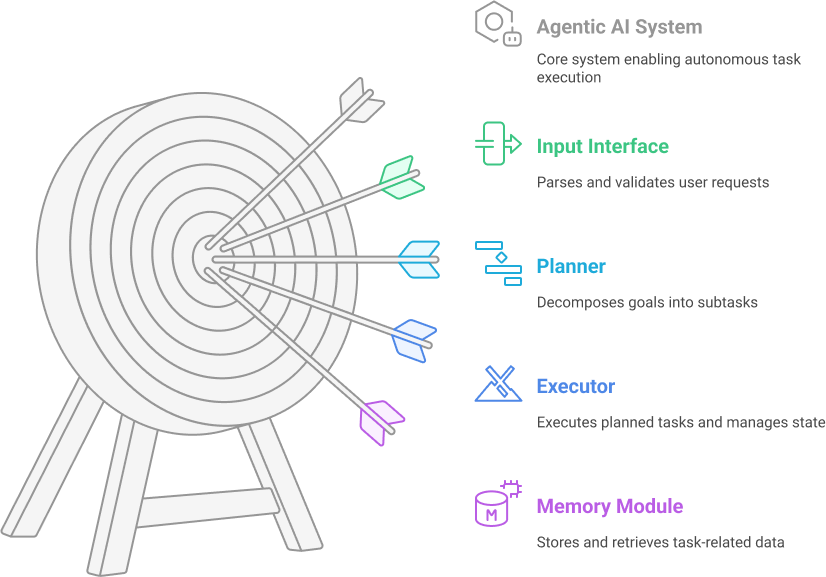
1. The model: your reasoning engine
The LLM interprets instructions, generates intermediate steps, reasons over data, evaluates outcomes and produces output in natural language or structured formats. In practice you’re choosing between hosted frontier models from providers like OpenAI, Anthropic and Google, and open-weight models such as Llama that you can run yourself when data has to stay on your own infrastructure. What matters for agents is less raw benchmark score than how reliably the model calls tools, follows instructions over many steps, and fits your latency and cost budget. Model lineups change every few months, so check each provider’s docs for the current one.
2. Planning
The planner turns a high-level goal into concrete, executable steps. There are two broad strategies:
- Prompt-level planning: the LLM plans inside the prompt using patterns like ReAct (Reason + Act), Chain of Thought or Tree of Thoughts. Lightweight, but limited in control and observability.
- External orchestration: a graph or state-machine framework (LangGraph, or workflows in Microsoft Agent Framework) supplies loops, conditional branches and failure handling around the model.
3. Memory
Memory gives an agent persistence. It lets the system recall prior inputs and results, maintain context across long tasks and adapt to history. It usually comes in three forms:
- Short-term memory: the working context of the current task loop, passed to the model on each step.
- Long-term memory: stored outside the model, often in a vector database such as Pinecone, Weaviate, Chroma or FAISS, and retrieved by embedding similarity (see RAG).
- Episodic memory: a record of what was tried and what failed in this session, so the agent doesn’t repeat itself.
What goes into the context window, and when, is now a discipline of its own. I cover it in What is Context Engineering?
4. Tools and the execution environment
A tool is anything the agent can execute outside the model: an API call, a database query, a file parser, a browser or a shell command. Modern models call tools through function schemas, and the Model Context Protocol (MCP) has become the common way to expose tools and data to agents (more on that below). Whatever the mechanism, the execution layer needs parameter validation, rate limits, timeouts, sandboxing and least-privilege access, because this is where an agent’s mistakes become real-world actions.
5. Reflection and evaluation
This layer lets the agent check whether a step worked and whether to proceed, retry or revise. It can be LLM-based (the model critiques its own output) or external (a separate evaluator, rules, checksums or defined success criteria). Reflection is what turns “task completion” into course correction.
6. The control loop (agent runtime)
The runtime, often called the harness, manages the agent’s lifecycle: success and failure conditions, retries, alternative plans, timeouts and budgets, concurrency limits, and when to stop. Set hard limits on steps, tokens and wall-clock time. An agent without them can loop indefinitely on your bill.
7. Multi-agent coordination (optional)
Multi-agent systems split work between specialised agents (planner, researcher, coder, reviewer) and need routing, shared memory and dependency tracking between them. It’s powerful and it multiplies cost and failure modes, so start with one agent and split only when a single one is demonstrably struggling.
8. Observability and guardrails
To trust an autonomous system you must be able to see what it did: prompts, tool calls, model responses, execution paths, latency, success rate and retries. Pair that with guardrails, meaning validation of inputs and outputs and human approval for high-impact actions. Most modern SDKs ship tracing and guardrail hooks for exactly this reason.
The standards connecting agents: MCP, A2A and AGENTS.md
One big change since this post was first written is that the plumbing between agents and the outside world is being standardised:
- MCP (Model Context Protocol) is an open standard for connecting models and agents to tools, data and applications. In December 2025 Anthropic donated it to the Agentic AI Foundation, a Linux Foundation fund co-founded by Anthropic, Block and OpenAI. Google, Microsoft and AWS are among the foundation’s supporters. Details in What is MCP?
- A2A (Agent2Agent) is an open protocol for communication between independent agents, possibly built on different frameworks. Google contributed it to the Linux Foundation in 2025. A helpful way to remember the split: MCP connects an agent to its tools, A2A connects agents to each other.
- AGENTS.md is a simple convention, also part of the Agentic AI Foundation, for giving coding agents project-specific guidance in a predictable file.
Practically, this means a tool you wrap once as an MCP server can be used by agents built with most of the frameworks below, which lowers the cost of switching frameworks later.
Agentic AI Frameworks You Can Use Today
You don’t need to build the agent loop from scratch. The frameworks below are the ones I’d look at in 2026, each with a different sweet spot.
Which should you choose?
- Use LangGraph (or Microsoft Agent Framework workflows) when you need predictable flows, retries, approvals and resumable long-running runs.
- Use Microsoft Agent Framework if you’re a .NET or Azure team, or you’re migrating off AutoGen or Semantic Kernel.
- Use the OpenAI Agents SDK for the shortest path on OpenAI models with guardrails and tracing included.
- Use the Claude Agent SDK when your agent needs to work with files, code and terminals, or you want a battle-tested agent loop.
- Use CrewAI if a team-of-roles metaphor fits how you think about the problem.
- Use MetaGPT to explore multi-role software generation, not as a default production choice.
- Use plain code with your provider’s tool calling if your needs don’t justify a framework. Often they don’t.
Also worth a look: Google’s open-source Agent Development Kit (model-agnostic, Python first with Java, Kotlin, Go and TypeScript support, and MCP tools) and the open-source Strands Agents SDK (Python and TypeScript, MCP built in).
What I removed from the earlier list, and why: AutoGen is now in maintenance mode, and Microsoft recommends Agent Framework for new projects. AgentLite is a Salesforce AI Research library whose last releases were in 2024, so it’s a research artefact more than a production choice. Superagent has pivoted from an agent-building platform to an open-source SDK for agent safety (blocking prompt injection, redacting PII), which is useful, but it isn’t an agent framework anymore.
Regardless of framework, building agentic systems demands a shift in mindset: from generating outputs to managing agents with memory, reasoning and persistence.
What are the Real-world applications of Agentic AI?
I’ve spent a lot of time experimenting with agentic systems: building, debugging, and watching them in action. And the more I interact with them, the more convinced I am that we’re looking at the foundation for the next layer of AI-native software. Below are some real-world scenarios where Agentic AI doesn’t just fit, it makes more sense than any traditional pattern I’ve seen before.
1. Autonomous Research Agents
One of the most natural applications is research automation. Whether it’s competitive analysis, legal scanning, or summarizing large volumes of documentation—agentic systems can carry out multi-step tasks with autonomy. You give the agent a goal like “Find all AI-related acquisitions in the last 12 months and generate a report,” and it breaks that into subtasks:
- Identify sources
- Scrape or query data
- Summarize findings
- Format the output
Traditional chatbots fail here because they can’t persist state or retry logic. Agentic agents can reflect, revise, and re-execute until the result is complete. That’s the game-changer.
2. Codebase Navigation and Automated Refactoring
When working with large codebases, I often need answers that require looking across multiple files, functions, and context layers. This is where a single prompt falls short. An agentic coding assistant can:
- Parse the architecture
- Search across modules
- Suggest changes based on goals like “Replace all deprecated methods in auth logic”
- Execute or simulate patches
Multi-agent setups make this practical by assigning specialised roles to agents (e.g., reader, planner, coder, reviewer). This division of responsibility mirrors how real teams work, and it works surprisingly well for software tasks. Coding agents are now the use case most developers meet first. If you’re choosing one, I compared two of the main options in Claude Code vs Cursor.
3. Backend Workflow Automation
Not every automation needs a drag-and-drop builder. Sometimes, you need an intelligent backend service that reacts to events, applies logic, fetches data from various APIs, and takes action—all without scripting everything manually.
I’ve tested agentic APIs where the logic layer is completely LLM-driven:
- A webhook triggers the agent
- The agent checks data from multiple APIs
- Applies decision rules
- Sends a response to another system
This enables dynamic, condition-aware flows that aren’t hardcoded in advance. Think of it as API-level RPA with reasoning.
4. Personalized Customer Support and Follow-ups
LLMs alone are great for templated answers. But they’re not enough when a response depends on memory, history, and external actions. An agentic support agent can:
- Recall prior tickets
- Check the CRM for plan details
- Trigger workflows (e.g., “issue refund,” “escalate to human”)
- Loop back with a confirmation
This pattern fits enterprise customer service teams who want more than just AI that talks—they need AI that acts. The best part? These agents don’t just respond—they make decisions.
5. Automated Decision-Making in Business Systems
I see a lot of value in using agentic systems to build decision layers on top of CRMs, ERPs, and marketing stacks. For instance:
- “Pause campaigns if ROI drops below threshold for two days.”
- “Reassign leads if last activity was more than 7 days ago.”
These are rule-based, but with context and variation. Agentic AI can evaluate, decide, and act using internal data, without needing dozens of conditional branches.
This makes them useful for marketing ops, sales intelligence, and workflow governance—without turning every use case into a hard-coded decision tree.
6. Data Enrichment and Smart Pipelines
Imagine feeding a lead list to an agent and having it:
- Search for LinkedIn profiles
- Validate email addresses
- Enrich with public data
- Prioritize based on fit
I’ve built prototypes for this with LangGraph and memory-backed agents. The autonomy here eliminates dozens of manual checks. It’s especially useful in ops-heavy workflows like B2B sales, hiring, or legal analysis.
Agentic AI isn’t just a research experiment anymore. These use cases aren’t future-looking—they’re feasible now. And from what I’ve seen, the more complex or long-running the task, the more useful agentic patterns become.
Challenges and Limitations
While I’m optimistic about where Agentic AI is heading, I’d be dishonest if I said it’s production-ready in every context. There are real constraints, and I’ve run into many of them while testing and deploying agentic systems.
1. Reliability and Hallucination
Even with well-scoped goals, agents can drift. They hallucinate tools, invent data, or misinterpret instructions—especially in open-ended or poorly constrained tasks. Without strict tool definitions and validation layers, the risk of flawed outcomes remains high.
2. Latency and Cost
Multi-step reasoning isn’t cheap. Every planning step, reflection pass, or retry adds to token usage and latency. I’ve seen simple agent flows take 30–60 seconds—too slow for real-time use. Running agents at scale also introduces compute costs that escalate fast.
3. Debugging and Observability
Tracing where an agent failed, why it chose a specific path, or why it didn’t act is far from trivial. Without robust logging and state tracking, debugging becomes guesswork. And since many components (planner, executor, memory) are loosely coupled, it’s hard to pinpoint failure points without custom tooling.
4. Tool and API Safety
Safeguards are essential when agents have access to powerful tools or production APIs. I’ve learned the hard way that without guardrails—timeouts, usage quotas, validation schemas—you’re trusting an LLM with too much authority. That’s not acceptable for high-risk environments.
Security goes beyond timeouts and quotas. An agent that reads untrusted content (web pages, emails, documents) can be manipulated by instructions hidden in that content, a problem known as prompt injection. OWASP lists Excessive Agency (LLM06:2025) among the top risks for LLM applications: giving a model more functions, permissions or autonomy than the task needs. The mitigations are the boring ones that work: expose the minimum set of tools, grant the minimum permissions, avoid open-ended tools like “run any shell command”, enforce access control in the downstream system instead of trusting the model, and require human approval for high-impact actions.
5. Limited Generalization
Finally, while agents handle structured workflows well, they still struggle with generalization across task types. You can’t just say “be useful” and expect consistent results. Each use case still demands design effort—prompt tuning, memory structuring, and fallback strategies.
The industry data backs up the caution. In June 2025 Gartner predicted that over 40% of agentic AI projects would be cancelled by the end of 2027, citing rising costs, unclear business value and inadequate risk controls, while still expecting at least 15% of day-to-day work decisions to be made autonomously by agentic AI by 2028. The technology isn’t the problem so much as building agents where a simpler solution, or a clearer business case, was needed.
So yes, agentic systems are powerful—but they’re not plug-and-play. For now, they work best when you design them intentionally, test their reasoning boundaries, and build in observability from day one. That’s how I approach it, and that’s what I’d recommend to anyone building with this paradigm.
Before you build an agent: a product checklist
If you’re the person deciding whether to build one (a PM, founder or tech lead), these are the questions I’d answer first. They’re the same questions that belong in a PRD for any agentic feature.
- What job is it doing, and could a workflow do it? If the steps are predictable, build the workflow.
- How much autonomy, exactly? Decide per action: suggest only, act with approval, or act alone. High-impact and irreversible actions should start in the first two.
- What does success look like, in numbers? Task success rate, cost per completed task, time to completion and how often it escalates to a human.
- What’s the failure budget? Define what a bad outcome costs and which mistakes are unacceptable, then design guardrails around those.
- Where does a human step in? Design the approval points and the handoff experience before the happy path.
- What can it touch? List every tool and permission, and remove everything the task doesn’t strictly need.
- How will you roll it out? Shadow mode first (it proposes, humans act), then assisted, then autonomous for the cases that have earned it.
- What will it cost at scale? Multi-step runs multiply token spend and latency, so model the cost per task before launch, not after.
If you want to build agents without writing code, our comparison of the best n8n alternatives for AI agents covers the main no-code and open-source platforms.
Conclusion
Agentic AI is not a concept I view as optional anymore—it’s becoming a foundational approach to building systems that can reason, plan, and act autonomously. Unlike traditional LLM implementations that treat prompts as isolated tasks, agentic systems operate with context, persistence, and clear execution goals.
From what I’ve observed, this shift isn’t theoretical. It’s already happening across developer tools, backend automations, and data-driven workflows. What excites me most is that agentic design doesn’t just extend what LLMs can do—it introduces a completely new interaction pattern. A pattern where software can adapt, retry, and coordinate without being micromanaged.
That said, it’s not a solved problem. Designing stable, secure, and observable agentic systems still requires deliberate engineering. But if you’re serious about building long-living AI systems that do more than respond to prompts—this is where you should be looking.
Frequently Asked Questions
What exactly is Agentic AI?
Agentic AI refers to AI systems built around autonomous agents that pursue defined goals by reasoning, planning, and interacting with tools or data sources. These agents maintain state, adapt based on feedback, and work through multi-step logic without direct human input at each stage.
Is an “AI agent” the same thing as “Agentic AI”?
Yes, in how the terms are used today. “AI agent” is the older, broader computer-science term for anything that perceives and acts on an environment (going back to classical work like Russell & Norvig’s PEAS framework). “Agentic AI” is the 2023-onward term for the specific case of an LLM wired up with planning, memory and tools to act autonomously. Outside academic contexts, people now use the two interchangeably, which is exactly why this post covers both.
How is Agentic AI different from traditional LLMs?
A traditional LLM call is a stateless prompt-and-response. Agentic AI adds a loop around the model: goals, planning, memory, tool use and self-correction, so the system can carry out an entire workflow instead of answering an isolated prompt.
What is the difference between an AI workflow and an AI agent?
In a workflow, your code defines the path and the LLM fills in steps. In an agent, the LLM decides the path and which tools to use. Workflows are more predictable and cheaper; agents suit open-ended problems where the steps can’t be predicted in advance.
Is Agentic AI just another buzzword?
No, but it is often misapplied. The architecture is grounded in decades of agent-based software design, now practical thanks to capable LLMs. The difference lies in how the model is used, not the model itself. Many projects that call themselves agentic would be better as simple workflows.
What frameworks can I use to build Agentic AI?
Popular options in 2026 include LangGraph, Microsoft Agent Framework (the successor to AutoGen and Semantic Kernel), CrewAI, the OpenAI Agents SDK, the Claude Agent SDK and Google’s Agent Development Kit. Plain code with your provider’s tool calling is often enough for simple cases.
What is MCP and how does it relate to agents?
The Model Context Protocol is an open standard for connecting AI models and agents to external tools, data and applications. It is now governed by the Agentic AI Foundation under the Linux Foundation, and most major agent frameworks can use MCP servers as tools.
What are the risks of using Agentic AI in production?
The biggest risks are hallucination, lack of execution transparency, cost and latency, prompt injection, and excessive agency, meaning too much access to tools and permissions. They can be mitigated with validation layers, step and budget limits, audit logging, least-privilege tool access and human approval for high-impact actions.