
OpenAI introduces Sora, a groundbreaking text-to-video model that represents a significant leap forward in artificial intelligence. Sora can transform textual descriptions into dynamic, realistic videos. This advancement opens new possibilities for a wide range of applications, from content creation to educational tools. This article aims to provide a comprehensive understanding of the technical architecture and operational mechanics behind Sora. Targeted at developers and technical professionals, we will explore the intricacies of how Sora works, from its foundational technologies to the step-by-step process that turns text into video. Our focus is to demystify the complexities of Sora, presenting the information in a straightforward, accessible manner.
Updated September 2026: OpenAI discontinued Sora entirely on September 24, 2026 — the app, sora.com, and the developer API are all gone. After peaking near a million users, usage fell below 500,000 while the product reportedly burned about $1 million a day in compute, and OpenAI redirected that spend elsewhere ahead of its IPO. You can no longer sign up for or generate video with Sora. What follows is a corrected, still-useful explanation of the technique Sora actually used — a diffusion transformer, not the GAN/RNN pipeline this article originally (and incorrectly) described — because that same technique is what today’s leading video models (Google’s Veo, Kling, Runway’s Gen-4 family) are built on. Where the shutdown changes what’s practically true, it’s called out below.
Understanding the Basics
Text-to-video AI models, such as Sora, convert written text into visual content by integrating several key technologies: natural language processing (NLP), computer vision, and generative algorithms. These technologies work in tandem to ensure the accurate and effective transformation of text into video.
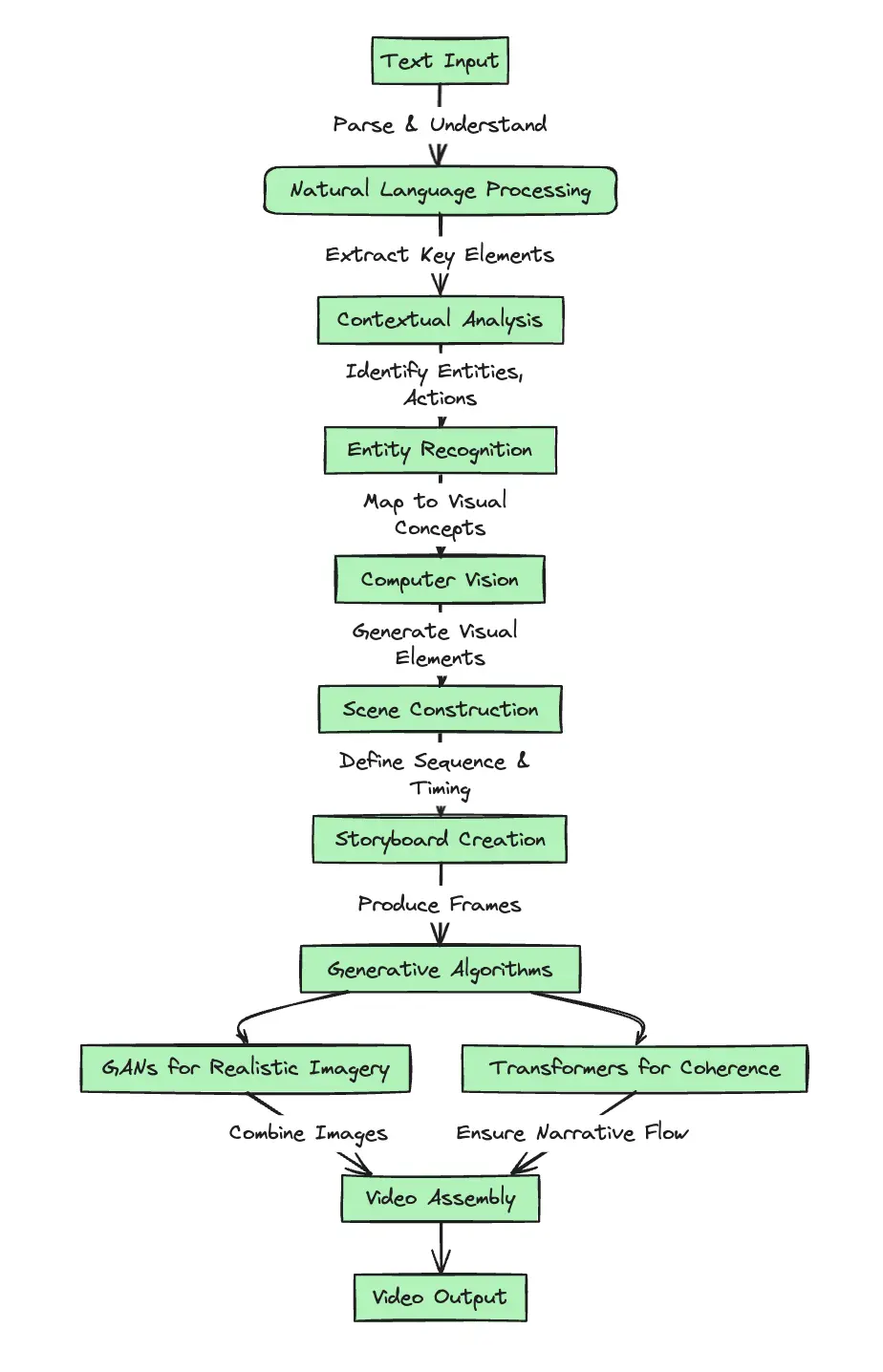
- Natural Language Processing (NLP) enables the model to parse and understand the text input(like a language model). This technology breaks down sentences to grasp the context, identify key entities, and extract the narrative elements that need visual representation.
- Computer Vision is responsible for the visual interpretation and generation of elements described in the text. It identifies and creates objects, environments, and actions, ensuring the video matches the textual description in detail and intent.
- Generative Algorithms turn the interpreted text into pixels. Early text-to-video attempts leaned on Generative Adversarial Networks (GANs); most current systems, Sora included, instead use diffusion models paired with a transformer backbone, which scale to longer, higher-resolution video far more reliably than GANs do.
These technologies collectively enable a text-to-video AI model to understand written descriptions, interpret them into visual elements, and generate cohesive, narrative-driven videos.
The diagram shows the sequential flow from receiving text input to generating a video output. It highlights the crucial roles played by NLP in understanding text, computer vision in visualizing the narrative, and generative algorithms in creating the final video, ensuring a comprehensive understanding of the basics behind text-to-video AI technology.
Also Read: How to create Local AI platform with Ollama and Open WebUI?
Technical Architecture of Sora
Having established a foundational understanding of the technologies that drive text-to-video models, we now turn our focus to the technical architecture of Sora. This section delves into the intricacies of Sora’s design, highlighting how it leverages advanced AI techniques to transform textual descriptions into vivid, coherent videos. We will explore the key components of Sora’s architecture, including data processing, model architecture, training methodologies, and performance optimization strategies. Through this examination, we aim to shed light on the sophisticated engineering that enables Sora to set new benchmarks in the field of AI-driven video generation. Let’s begin by exploring the first critical aspect of Sora’s technical architecture: data processing and input handling.
Data Processing and Input Handling
A critical initial step in Sora’s operation involves processing the textual data input by users and preparing it for the subsequent stages of video generation. This process ensures that the model not only understands the content of the text but also identifies the key elements that will guide the visual output. The following explains how Sora handles data processing and input.
- Text Input Analysis: Upon receiving a textual input, Sora first performs an in-depth analysis to parse the content. This analysis involves breaking down the text into manageable components, such as sentences and phrases, to better understand the narrative or description provided by the user.
- Contextual Understanding: The next step focuses on grasping the context behind the input text. Sora employs NLP techniques to interpret the semantics of the text, recognizing the overall theme, mood, and specific requests embedded within the input. This understanding is crucial for accurately reflecting the intended message in the video output.
- Key Element Extraction: With a clear grasp of the text’s context, Sora then extracts key elements such as characters, objects, actions, and settings. This extraction is essential for determining what visual elements need to be included in the generated video.
- Preparation for Visual Mapping: The extracted elements serve as a blueprint for the subsequent stages of video generation. Sora maps these elements to visual concepts that will be used to construct the scenes, ensuring that the video accurately represents the textual description.
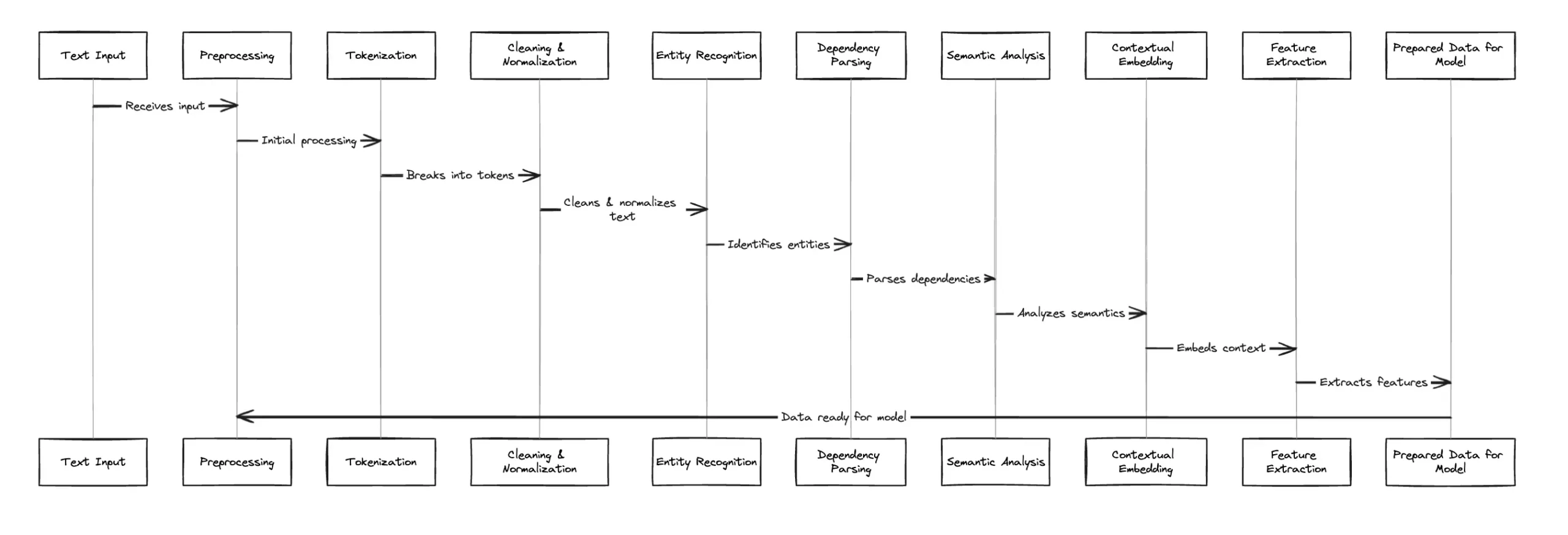
This diagram succinctly captures the initial phase of Sora’s technical architecture, emphasizing the importance of accurately processing and handling textual input. By meticulously analyzing and preparing the text, Sora lays the groundwork for generating videos that are not only visually compelling but also faithful to the user’s original narrative. This careful attention to detail in the early stages of data processing and input handling is what enables Sora to achieve remarkable levels of creativity and precision in video generation.
Also Read: How do Large Language Models work?
Model Architecture
Correction: earlier versions of this article described Sora’s architecture as an integration of Generative Adversarial Networks (GANs), Recurrent Neural Networks (RNNs), and Transformer models. That was never accurate for Sora, and it’s worth explaining why, since the GAN/RNN framing is a common misconception about how modern text-to-video actually works. Sora is a diffusion transformer (DiT) operating on spacetime patches — a single model family, not three stitched together.
Why not GANs?
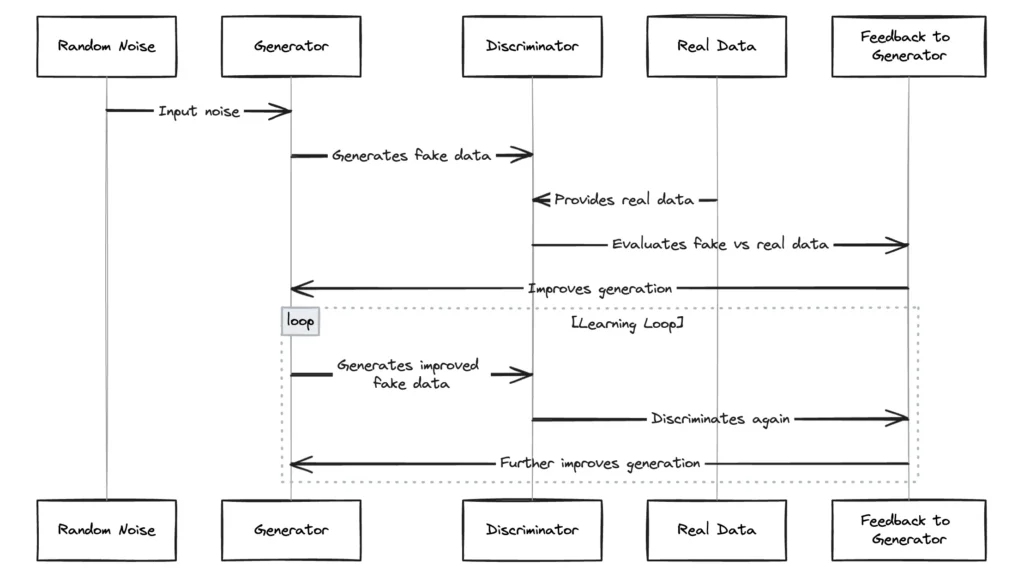
GANs pit a generator against a discriminator until the generator’s output is indistinguishable from real data. They can produce sharp individual images, but training is notoriously unstable at scale, and GANs don’t naturally extend to variable-length, variable-resolution video — the output size has to be fixed in advance. That made them a poor fit for a model meant to generate videos from seconds to roughly a minute long, at multiple resolutions and aspect ratios.
Why not RNNs?
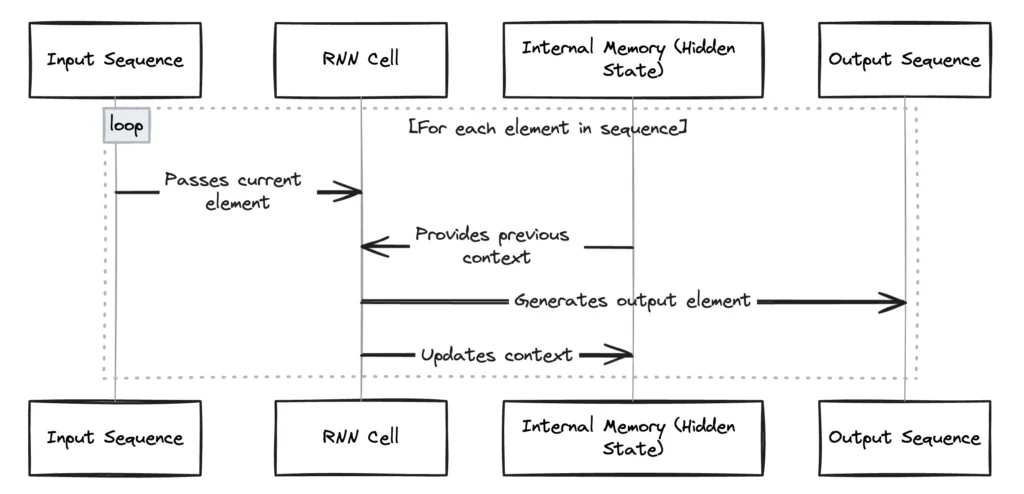
RNNs process sequences one step at a time, carrying a hidden state forward frame by frame. That sequential dependency is exactly what makes them slow to train on long sequences (video, unrolled into frames, is a very long sequence) and prone to losing context over distance. Transformers replaced RNNs for text for the same reason: self-attention lets every position see every other position at once, in parallel, instead of waiting its turn.
What Sora actually uses: a Diffusion Transformer on spacetime patches
Sora’s real pipeline, as OpenAI described it in its technical report, works roughly like this:
- Compress to a latent space. A video compression network (a variational autoencoder) first shrinks raw video into a smaller, lower-dimensional latent representation — the same trick DALL·E and Stable Diffusion use for images, extended into time.
- Patchify. That latent video is chopped into spacetime patches — small chunks of space and time, analogous to how a language model breaks text into tokens. A short, low-res clip becomes a shorter sequence of patches than a long, high-res one, which is what lets Sora handle variable durations and resolutions with one model instead of a different network per size.
- Condition on text. The prompt is encoded (OpenAI reused the recaptioning approach from DALL·E 3: training a separate captioner to write highly descriptive captions for training videos, then training Sora on those captions) into an embedding that guides generation.
- Denoise with a transformer. Starting from pure noise patches, a transformer — not a GAN, not an RNN — is trained to iteratively predict and remove noise, step by step, conditioned on the text embedding, until the patches converge on a coherent latent video. This is the “diffusion” part: the model learns to reverse a noising process rather than generating pixels in one shot.
- Decode back to pixels. The decompression network (the inverse of step 1) turns the denoised latent patches back into a normal video file.
The self-attention mechanism inside that transformer is what gives Sora long-range coherence — the same mechanism a text-only transformer uses to relate a pronoun to a noun several sentences earlier now relates a pixel region in frame 40 to a pixel region in frame 4, so an object that leaves the frame and comes back still looks like the same object. There’s no separate RNN “managing” narrative continuity; it falls out of attention operating across the full spacetime patch sequence.
Training Data and Methodologies
The effectiveness of Sora in generating realistic and contextually accurate videos from textual descriptions is significantly influenced by its training data and methodologies. This section explores the types of datasets used for training Sora and delves into the detailed training process, including strategies like fine-tuning and transfer learning.
Types of Datasets Used for Training Sora:
Sora’s training involves a diverse range of datasets, each contributing to the model’s understanding of language, visual elements, and their interrelation. Examples of these datasets include:
- Natural Language Datasets: Collections of textual data that help the model learn language structures, grammar, and semantics. Examples include large corpora like Wikipedia, books, and web text, which offer a broad spectrum of language use and contexts.
- Visual Datasets: These datasets consist of images and videos annotated with descriptions. They enable Sora to learn the correlation between textual descriptions and visual elements. Examples include MS COCO (Microsoft Common Objects in Context) and the Visual Genome, which provide extensive visual annotations.
- Video Datasets: Specifically for understanding temporal dynamics and narrative flow in videos, datasets like Kinetics and Moments in Time are used. These datasets contain short video clips with annotations, helping the model learn how actions and scenes evolve.
Training Process:
OpenAI never disclosed Sora’s exact training set, parameter count, or compute budget. What is documented, from the technical report and later reporting, is the shape of the process:
- Recaptioning: a captioning model is trained to generate detailed, descriptive text for videos in the training set (the same approach used for DALL·E 3), because highly descriptive captions produce much better text-following than the short, sparse captions typically scraped from the web.
- Large-scale diffusion training: the diffusion transformer is trained directly on videos and images at their native sizes, spanning widescreen 1920×1080, vertical 1080×1920, and everything in between, rather than resizing or cropping everything to one fixed shape first.
- Post-training and safety fine-tuning: after the base model can generate coherent video, it goes through additional fine-tuning passes aimed at output quality and, especially after the deepfake and likeness controversies that followed Sora 2’s launch in late 2025, at enforcing content and consent policies.
Performance Optimization
In the development of Sora, performance optimization plays a critical role in ensuring that the model not only generates high-quality videos but also operates efficiently. This subsection explores the techniques and strategies employed to optimize Sora’s performance, focusing on computational efficiency, output quality, and scalability.
- Computational Efficiency: To enhance computational efficiency, Sora incorporates several optimization techniques:
- Model Pruning: This technique reduces the complexity of the neural networks by removing neurons that contribute little to the output. Pruning helps in reducing the model size and speeds up computation without significantly affecting performance.
- Quantization: Quantization involves converting a model’s weights from floating-point to lower-precision formats, such as integers, which reduces the model’s memory footprint and speeds up inference times.
- Parallel Processing: Leveraging GPU acceleration and distributed computing, Sora processes multiple components of the video generation pipeline in parallel, significantly reducing processing times.
- Output Quality: Maintaining high output quality is paramount. To this end, Sora employs:
- Adaptive Learning Rates: By adjusting the learning rates dynamically, Sora ensures that the model training is efficient and effective, leading to higher-quality outputs.
- Regularization Techniques: Techniques such as dropout and batch normalization prevent overfitting and ensure that the model generalizes well to new, unseen inputs, thus maintaining the quality of the generated videos.
- Scalability: To address scalability, Sora uses:
- Modular Design: The architecture of Sora is designed to be modular, allowing for easy scaling of individual components based on the computational resources available or the specific requirements of a task.
- Dynamic Resource Allocation: Sora dynamically adjusts its use of computational resources based on the complexity of the input and the desired output quality. This allows for efficient use of resources, ensuring scalability across different operational scales.
- Efficiency and Quality Enhancement:
- Batch Processing: Where possible, Sora processes data in batches, allowing for more efficient use of computational resources by leveraging vectorized operations.
- Advanced Encoding Techniques: For video output, Sora uses advanced encoding techniques to compress video data without significant loss of quality, ensuring that the generated videos are not only high in quality but also manageable in size.
Through these optimization strategies, Sora achieves a balance between computational efficiency, output quality, and scalability, making it a powerful tool for generating realistic and engaging videos from textual descriptions. This careful attention to performance optimization ensures that Sora can meet the demands of diverse applications, from content creation to educational tools, without compromising on speed or quality.
How does Sora work?
After entering a prompt, Sora initiates a complex backend workflow to transform the text into a coherent and visually appealing video. This process leverages cutting-edge AI technologies and algorithms to interpret the prompt, generate relevant scenes, and compile these into a final video. The workflow ensures that user inputs are effectively translated into high-quality video content, tailored to the specified requirements. Here, we detail the backend operations from prompt reception to video generation, emphasizing the technology at each stage and how customization affects the outcome.
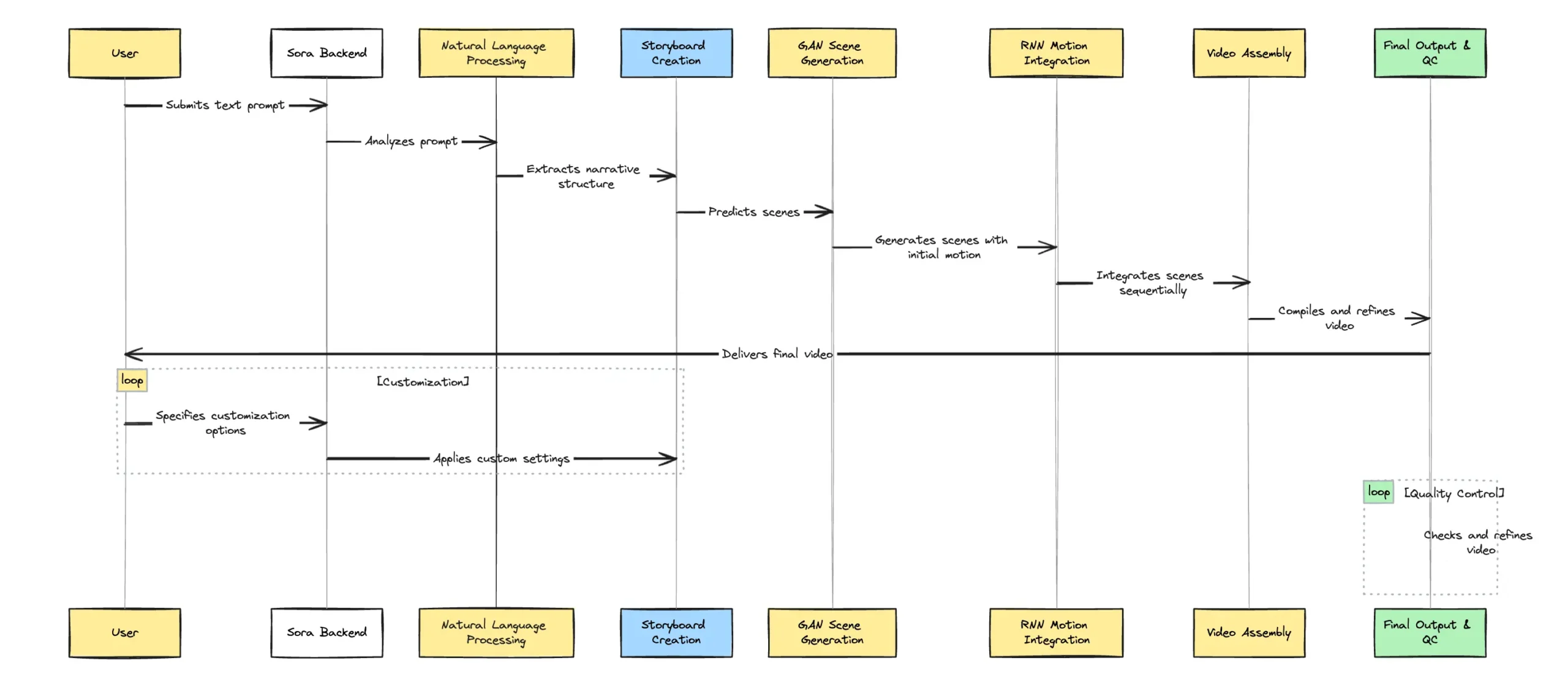
From Text to Video:
- Prompt Reception and Analysis: Upon receiving a text prompt, Sora first analyzes the input using natural language processing (NLP) technologies. This step involves understanding the context, extracting key information, and identifying the narrative structure of the prompt.
- Storyboard and Scene Prediction: Based on the analysis, Sora then creates an internal representation of the sequence of scenes that will make up the video — predicting the setting, characters, and actions that need to be visualized to match the narrative intent of the prompt.
- Latent Diffusion Denoising: With that conditioning in hand, Sora’s diffusion transformer starts from random noise spacetime patches and iteratively denoises them over many steps, guided by the text embedding, until a coherent latent video emerges. This single step replaces what the original version of this article incorrectly described as separate GAN scene-generation and RNN sequencing steps — here, both visual realism and temporal coherence come from the same denoising process operating over the full patch sequence at once.
- Decoding: The denoised latent patches are passed through the decompression network to produce the actual video frames, with motion emerging directly from how the patches were generated rather than as a separate animation pass bolted on afterward.
- Video Assembly: The decoded frames are compiled into a continuous video, with transitions and output encoding handled in this final step.
Customization and User Input
- Influence of User Inputs: User inputs significantly influence the generation process. Customization options allow users to specify characters, settings, and even the style of the video, guiding Sora in creating a video that matches the user’s vision.
- Capabilities for Customization: Sora offers a range of customization options, from basic adjustments like video length and resolution to more detailed specifications such as character appearance and scene settings. This flexibility ensures that the videos are not unique but also closely aligned with user preferences.
Real-time Processing and Output
- Generation Speed: Sora was not real-time — a clip typically took anywhere from under a minute to several minutes to generate, depending on length, resolution, and how many denoising steps were used. Faster settings traded some quality for speed; this trade-off is standard across diffusion-based video models, not unique to Sora.
- Output Formats: The final video is rendered in popular formats, ensuring compatibility across a wide range of platforms and devices. Sora 2’s outputs also carried a visible moving watermark by default, added specifically to make AI-generated video easier to identify after the app’s launch.
- Quality Control and Refinement: After the initial video generation, Sora implements quality control measures, reviewing the video for any inconsistencies or errors. If necessary, refinement processes are applied to enhance the visual quality, narrative coherence, and overall impact of the video.
Generated by OpenAI’s Sora
Through the combination of NLP-driven prompt understanding and a diffusion transformer denoising spacetime patches, Sora translated textual descriptions into video with a level of temporal coherence that GAN- and RNN-based approaches hadn’t achieved. Sora 2, released September 30, 2025, extended this with synchronized audio generation (dialogue, sound effects, and ambient sound predicted alongside the video itself), noticeably better adherence to real-world physics, and the “Cameos” feature that let users insert a verified likeness of themselves into generated scenes.
Current Status and Limitations
The most important limitation as of September 2026 is that Sora doesn’t exist anymore. Beyond that headline fact, it’s worth understanding both the technical limitations that were always true and the non-technical ones that turned out to matter more:
- Discontinued: OpenAI shut down the Sora app and sora.com on April 26, 2026, and closed the API on September 24, 2026, less than a year after Sora 2’s launch. There is no supported way to generate video with Sora today.
- The economics didn’t work: by OpenAI’s own account, Sora cost roughly $1 million a day to run, user numbers fell from a peak of around a million to under 500,000, and lifetime revenue was reported at only about $2.1 million — a gap no amount of technical improvement was going to close.
- Likeness and consent problems: Sora 2’s Cameo feature and its permissive default handling of copyrighted characters and public figures’ likenesses led to a wave of deepfakes (including of deceased public figures) within weeks of launch, forcing OpenAI to switch from an opt-out to an opt-in consent model in October 2025. Detection researchers later reported bypassing Sora 2’s anti-impersonation safeguards for every likeness they tried.
- Physics and complex language, even at the end: Sora 2 improved markedly on physical plausibility and prompt-following versus the original Sora, but neither version fully solved either problem — complex multi-object interactions and highly ambiguous prompts still produced visible errors.
- Compute cost, generally: the underlying lesson generalizes beyond Sora — diffusion transformer video generation is still far more compute-intensive per output than text or image generation, which is why it remains expensive across every vendor, not just the one that shut down.
If you want to actually generate video today, the technique described above didn’t go away with Sora — it’s the same family of architecture behind the models that now lead the space, including Google’s Veo, Kling, and Runway’s Gen-4 line.
Conclusion
Sora, OpenAI’s text-to-video model, was a genuine technical leap when it launched in February 2024: a diffusion transformer operating on spacetime patches, not the GAN-and-RNN pipeline earlier versions of this article described, capable of turning a text prompt into a coherent, minute-long video. Sora 2 pushed that further in September 2025 with synchronized audio and noticeably better physics. Neither version, however, solved the economics of running that model at scale, and OpenAI discontinued the entire product — app, web, and API — by September 2026.
That doesn’t make the underlying technique obsolete. The diffusion-transformer-on-patches approach Sora popularized is now the default for text-to-video across the industry, and it’s a useful mental model for evaluating any current video generator: how does it compress video into a workable latent space, how does it patch that latent representation, and how is text conditioning actually wired into the denoising process. Sora’s specific product is gone, but the architecture it demonstrated is very much still how this class of model works.
People Also Ask for:
How does SORA differ from traditional diffusion models in video generation?
SORA combines a diffusion transformer (DiT) architecture with spacetime latent patches, enabling it to process video frames as spatiotemporal tokens. Unlike standard diffusion models that operate on pixels or fixed latent spaces, SORA’s patch-based approach allows for dynamic scaling and longer context retention.
What role does the “visual tokenizer” play in SORA’s workflow?
The visual tokenizer (likely a VQ-VAE or similar) compresses raw video frames into discrete latent representations. This reduces computational overhead and enables the transformer to process videos as sequences of patches—similar to how LLMs handle text tokens.
Why does SORA use a diffusion transformer instead of a pure autoregressive model?
Diffusion transformers offer better scalability for high-dimensional data (like video) and mitigate the compounding error problem of autoregressive models. The DiT architecture also allows for parallel training and efficient long-range dependency modeling.
How does SORA handle variable-length video generation?
By treating videos as spacetime patches, SORA can dynamically adjust the number of tokens based on duration and resolution. The transformer’s attention mechanism scales across these patches, enabling flexible generation without fixed frame limits.
What are the key challenges in SORA’s training pipeline?
1. Data diversity: Requires massive, high-quality video datasets with precise temporal alignment.
2. Compute cost: Training DiTs on video data demands exa-scale GPU/TPU resources.
3. Temporal coherence: Maintaining consistency across long sequences is non-trivial (addressed via recaptioning and causal attention).
Does SORA support multimodal inputs (e.g., text + image conditioning)?
Yes. SORA likely uses cross-modal embeddings (e.g., CLIP for text, ViT for images) to align prompts with latent patches. This enables hybrid conditioning, such as animating a static image via text instructions.
Are there open-source alternatives to SORA’s architecture?
By 2026, yes: Tencent’s HunyuanVideo, Genmo’s Mochi, Alibaba’s Wan2.2, and LTX-Video all use diffusion transformer architectures similar in spirit to SORA’s, and their weights are publicly downloadable. None matched Sora 2’s output quality at launch, but the gap has narrowed considerably since 2024, and SORA itself was discontinued in 2026 while these open alternatives are still actively maintained.